jueves, 24 de julio de 2014

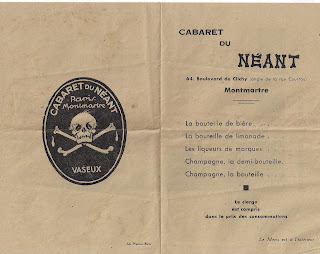
Cabaret du Néant

http://www.madametalbot.com/pix/oddments/funlamp1.jpg  

  “As we neared the Place we saw on the opposite side of the street two flickering iron lanterns that threw a ghastly green light down upon the barred dead-black shutters of the building, and caught the faces of the passers-by with sickly rays that took out all the life and transformed them into the semblance of corpses. Across the top of the closed black entrance were large white letters, reading simply:    

 CAFE DU NEANT

    The entrance was heavily draped with black cerements, having white trimmings, such as hang before the houses of the dead in Paris. Here patrolled a solitary croque-mort, or hired pall-bearer, his black cape drawn closely about him, the green light reflected by his glazed top-hat. A more dismal and forbidding place it would be difficult to imagine. Mr. Thompkins paled a little when he discovered that this was our destination, this grisly caricature of eternal nothingness, and hesitated at the threshold. Without a word Bishop firmly took his arm and entered. The lonely croque-mort drew apart the heavy curtain and admitted us into a black hole that proved later to be a room. The chamber was dimly lighted with wax tapers, and a large chandelier intricately devised of human skulls and arms, with funeral candles held in their fleshless fingers, gave its small quota of light.

    Large, heavy, wooden coffins, resting on biers, were ranged about the room in an order suggesting the recent happening of a frightful catastrophe. The walls were decorated with skulls and bones, skeletons in grotesque attitudes, battle-pictures, and guillotines in action. Death, carnage, assassination were the dominant note, set in black hangings and illuminated with mottoes on death. A half-dozen voices droned this in a low monotone: "Enter, mortals of this sinful world, enter into the mists and shadows of eternity. Select your biers, to the right, to the left; fit yourselves comfortably to them, and repose in the solemnity and tranquillity of death; and may God have mercy on your souls!"

    A number of persons who had preceded us had already pre-empted their coffins, and were sitting beside them awaiting developments and enjoying their consommations, using the coffins for their real purpose, tables for holding drinking-glasses. Alongside the glasses were slender tapers by which the visitors might see one another.

    There seemed to be no mechanical imperfection in the illusion of a charnel-house; we imagined that even chemistry had contributed its resources, for there seemed distinctly to be the odor appropriate to such a place. We found a vacant coffin in the vault, seated ourselves at it on rush-bottomed stools, and awaited further developments.

    Another croque-mort a garcon he was came up through the gloom to take our orders. He was dressed completely in the professional garb of a hearse-follower, including claw-hammer coat, full-dress front, glazed tile, and oval silver badge. He droned, "Bon soir, Macchabees! [This word (also Maccabe, argot Macabit) is given in Paris by sailors to cadavers found floating in the river] Buvez les crachats d'asthmatiques, voila des sueurs froides d'agonisants. Prenez done des certificats de deces, seulement vingt sous. C'est pas cher et c'est artistique !"

    Bishop said that he would be pleased with a lowly bock. Mr. Thompkins chose cherries a l'eau-de-vie, and I, une menthe.

    "One microbe of Asiatic cholera from the last corpse, one leg of a lively cancer, and one sample of our consumption germ!" moaned the creature toward a black hole at the farther end of the room. Some women among the visitors tittered, others shuddered, and Mr. Thompkins broke out in a cold sweat on his brow, while a curious accompaniment of anger shone in his eyes. Our sleepy pallbearer soon loomed through the darkness with our deadly microbes, and waked the echoes in the hollow casket upon which he set the glasses with a thump.

    "Drink, Macchabees!" he wailed: "drink these noxious potions, which contain thvilest and deadliest poisons!"

    "The villain!" gasped Mr. Thompkins; "it is horrible, disgusting, filthy!"

    The tapers flickered feebly on the coffins, and the white skulls grinned at him mockingly from their sable background. Bishop exhausted all his tactics in trying to induce Mr. Thompkins to taste his brandied cherries, but that gentleman positively refused, he seemed unable to banish the idea that they were laden with disease germs.

    After we had been seated here for some time, getting no consolation from the utter absence of spirit and levity among the other guests, and enjoying only the dismay and trepidation of new and strange arrivals, a rather good-looking young fellow, dressed in a black clerical coat, came through a dark door and began to address the assembled patrons. His voice was smooth, his manner solemn and impressive, as he delivered a well-worded discourse on death. He spoke of it as the gate through which we must all make our exit from this world, of the gloom, the loneliness, the utter sense of helplessness and desolation. As he warmed to his subject he enlarged upon the follies that hasten the advent of death, and spoke of the relentless certainty and the incredible variety of ways in which the reaper claims his victims. Then he passed on to the terrors of actual dissolution, the tortures of the body, the rending of the soul, the unimaginable agonies that sensibilities rendered acutely susceptible at this extremity are called upon to endure. It required good nerves to listen to that, for the man was perfect in his role. From matters of individual interest in death he passed to death in its larger aspects. He pointed to a large and striking battle scene, in which the combatants had come to hand-to-hand fighting, and were butchering one another in a mad lust for blood. Suddenly the picture began to glow, the light bringing out its ghastly details with hideous distinctness. Then as suddenly it faded away, and where fighting men had been there were skeletons writhing and struggling in a deadly embrace. A similar effect was produced with a painting giving a wonderfully realistic representation of an execution by the guillotine. The bleeding trunk of the victim lying upon the flap-board dissolved, the flesh slowly disappearing, leaving only the white bones. Another picture, representing a brilliant dance-hall filled with happy revellers, slowly merged into a grotesque dance of skeletons; and thus it was with the other pictures about the room.

    All this being done, the master of ceremonies, in lugubrious tones, invited us to enter the chambre de la mort. All the visitors rose, and, bearing each a taper, passed in single file into a narrow, dark passage faintly illuminated with sickly green lights, the young man in clerical garb acting as pilot. The cross effects of green and yellow lights on the faces of the groping procession were more startling than picturesque. The way was lined with bones, skulls, and fragments of human bodies.

    "O Macchabees, nous sommes devant la porte de la chambre de la mort!" wailed an unearthly voice from the farther end of the passage as we advanced. Then before us appeared a solitary figure standing beneath a green lamp. The figure was completely shrouded in black, only the eyes being visible, and they shone through holes in the pointed cowl. From the folds of the gown it brought forth a massive iron key attached to a chain, and, approaching a door seemingly made of iron and heavily studded with spikes and crossed with bars, inserted and turned the key; the bolts moved with a harsh, grating noise, and the door of the chamber of death swung slowly open.

    "O Macchabees, enter into eternity, whence none ever return!" cried the new, strange voice.

    The walls of the room were a dead and unrelieved black. At one side two tall candles were burning, but their feeble light was insufficient even to disclose the presence of the black walls of the chamber or indicate that anything but unending blackness extended heavenward. There was not a thing to catch and reflect a single ray of the light and thus become visible in the blackness.

    Between the two candles was an upright opening in the wall; it was of the shape of a coffin. We were seated upon rows of small black caskets resting on the floor in front of the candles. There was hardly a whisper among the visitors. The black-hooded figure passed silently out of view and vanished in the darkness.

    Presently a pale, greenish-white illumination began to light up the coffin-shaped hole in the wall, clearly marking its outline against the black. Within this space there stood a coffin upright, in which a pretty young woman, robed in a white shroud, fitted snugly. Soon it was evident that she was very much alive, for she smiled and looked at us saucily. But that was not for long. From the depths came a dismal wail: "O Macchabee, beautiful, breathing mortal, pulsating with the warmth and richness of life, thou art now in the grasp of death! Compose thy soul for the end!"

    Her face slowly became white and rigid; her eyes sank; her lips tightened across her teeth; her cheeks took on the hollowness of death, she was dead. But it did not end with that. From white the face slowly grew livid... then purplish black... The eyes visibly shrank into their greenish-yellow sockets... Slowly the hair fell away... The nose melted away into a purple putrid spot. The whole face became a semi-liquid mass of corruption. Presently all this had disappeared, and a gleaming skull shone where so recently had been the handsome face of a woman; naked teeth grinned inanely and savagely where rosy lips had so recently smiled. Even the shroud had gradually disappeared, and an entire skeleton stood revealed in the coffin. The wail again rang through the silent vault: "Ah, ah, Macchabee! Thou hast reached the last stage of dissolution, so dreadful to mortals. The work that follows death is complete. But despair not, for death is not the end of all. The power is given to those who merit it, not only to return to life, but to return in any form and station preferred to the old. So return if thou deservedst and desirest."

    With a slowness equal to that of the dissolution, the bones became covered with flesh and cerements, and all the ghastly steps were reproduced reversed. Gradually the sparkle of the eyes began to shine through the gloom; but when the reformation was completed, behold! there was no longer the handsome and smiling young woman, but the sleek, rotund body, ruddy cheeks, and self-conscious look of a banker. It was not until this touch of comedy relieved the strain that the rigidity with which Mr. Thompkins had sat between us began to relax, and a smile played over his face, a bewildered, but none the less a pleasant, smile. The prosperous banker stepped forth, sleek and tangible, and haughtily strode away before our eyes, passing through the audience into the darkness. Again was the coffin-shaped hole in the wall dark and empty.

    He of the black gown and pointed hood now emerged through an invisible door, and asked if there was any one in the audience who desired to pass through the experience that they had just witnessed. This created a suppressed commotion; each peered into the face of his neighbor to find one with courage sufficient for the ordeal. Bishop suggested to Mr. Thompkins in a whisper that he submit himself, but that gentleman very peremptorily declined. Then, after a pause, Bishop stepped forth and announced that he was prepared to die. He was asked solemnly by the doleful person if he was ready to accept all the consequences of his decision. He replied that he was. Then he disappeared through the black wall, and presently appeared in the greenish-white light of the open coffin. There he composed himself as he imagined a corpse ought, crossed his hands upon his breast, suffered the white shroud to be drawn about him, and awaited results, after he had made a rueful grimace that threw the first gleam of suppressed merriment through the oppressed audience. He passed through all the ghastly stages that the former occupant of the coffin had experienced, and returned in proper person to life and to his seat beside Mr. Thompkins, the audience applauding softly.

A mysterious figure in black waylaid the crowd as it filed out. He held an inverted skull, into which we were expected to drop sous through the natural opening there, and it was with the feeling of relief from a heavy weight that we departed and turned our backs on the green lights at the entrance”.

What a wonderful contrast ! Here we were in the free, wide, noisy, brilliant world again. Here again were the crowds, the venders, saucy grisettes with their bright smiles, shining teeth, and alluring glances. Here again were the bustling cafes, the music, the lights, the life, and above all the giant arms of the Moulin Rouge sweeping the sky.

"Now," quietly remarked Bishop, ••having passed through death, we will explore hell”…


William Chambers Morrow,
Bohemian Paris of To-day (1899)


http://www.faget-benard.com/jojo/images/pigalle/neant/f_paris_neant.jpg


https://blogger.googleusercontent.com/img/b/R29vZ2xl/AVvXsEg7ahZrNZTqfHku_bszlVgdmFAAtn2HwkQcfy_r5VkHIGnSoCqgXgpuSJqbbVfYzBAL_RuoHXYL-elnfbKoedujfYg_DVSe_FEgv9_WevAPjp0mTi4Epvnp1xX0r5_qBwZOlG3i2PS-Y4Wd/s320/cabaret+du+n%C3%A9ant.jpg


domingo, 2 de febrero de 2014

Fear and Loathing at the Super Bowl


". . . and whosoever was not found written into the book of life was cast into the lake of
fire. . ." -- Revelations 20:15

This was the theme of the sermon I delivered off the 20th floor balcony of the
Hyatt Regency in Houston on the morning of Super Bowl VIII. It was just before dawn, as I
recall, when the urge to speak came on me. Earlier that day I had found -- on the tile
floor of the Men's Room on the hotel mezzanine -- a religious comic book titled "A Demon's
Nightmare," and it was from the text of this sleazy tract that I chose the words of my
sermon.
The Houston Hyatt Regency -- like others designed by architect John Portman in
Atlanta and San Francisco -- is a stack of 1000 rooms, built around a vast lobby at least
30 stories high, with a revolving "spindletop" bar on the roof. The whole center of the
building is a tower of acoustical space. You can walk out of any room and look over the
indoor balcony (20 floors down, in my case) at the palm-shrouded, wood and naugahyde maze
of the bar/lounge on the lobby floor.
Closing time in Houston is 2:00 AM. There are after-hours bars, but the Hyatt
Regency is not one of them. So -- when I was seized by the urge to deliver my sermon at
dawn -- there were only about 20 ant-sized people moving around in the lobby far below.
Earlier, before the bar closed, the whole ground floor had been jammed with
drunken sportswriters, hard-eyed hookers, wandering geeks and hustlers (of almost every
persuasion), and a legion of big and small gamblers from all over the country who roamed
through the drunken, randy crowd -- as casually as possible -- with an eye to picking up a
last-minute sucker bet from some poor bastard half-mad on booze and willing to put some
money, preferably four or five big ones, on "his boys."
The spread, in Houston, was Miami by six, but by midnight on Saturday almost every
one of the two-thousand or so drunks in the lobby of the Regency -- official headquarters
and media vortex for this eighth annual Super Bowl -- was absolutely sure about what was
going to happen when the deal went down on Sunday, about two miles east of the hotel on
the fog-soaked artificial turf of Rice University stadium.
Ah. . . but wait! Why are we talking about gamblers here? Or thousands of hookers
and drunken sportswriters jammed together in a seething mob in the lobby of a Houston
hotel?
And what kind of sick and twisted impulse would cause a professional sportswriter
to deliver a sermon from the Book of Revelations off his hotel balcony on the dawn of
Super Sunday?
I had not planned a sermon for that morning. I had not even planned to be in
Houston, for that matter. . . But now, looking back on that outburst, I see a certain
inevitability about it. Probably it was a crazed and futile effort to somehow explain the
extremely twisted nature of my relationship with God, Nixon and the National Football
League: The three had long since become inseparable in my mind, a sort of unholy trinity
that had caused me more trouble and personal anguish in the past few months than Ron
Ziegler, Hubert Humphrey and Peter Sheridan all together had caused me in a year on the
campaign trail.
Or perhaps it had something to do with my admittedly deep-seated need to have
public revenge on Al Davis, general manager of the Oakland Raiders. . . Or maybe an
overweening desire to confess that I had been wrong, from the start, to have ever agreed
with Richard Nixon about anything, and especially pro football.
In any case, it was apparently something I'd been cranking myself up to deliver
for quite a while. . . and, for reasons I still can't be sure of, the eruption finally
occurred on the dawn of Super Sunday.
I howled at the top of my lungs for almost 30 minutes, raving and screeching about
all those who would soon be cast into the lake of fire, for a variety of low crimes,
misdemeanors and general ugliness that amounted to a sweeping indictment of almost
everybody in the hotel at that hour.
Most of them were asleep when I began speaking, but as a Doctor of Divinity and an
ordained minister in the Church of The New Truth, I knew in my heart that I was merely a
vessel -- a tool, as it were -- of some higher and more powerful voice.
For eight long and degrading days I had skulked around Houston with all the other
professionals, doing our jobs -- which was actually to do nothing at all except drink all
the free booze we could pour into our bodies, courtesy of the National Football League,
and listen to an endless barrage of some of the lamest and silliest swill ever uttered by
man or beast. . . and finally, on Sunday morning about six hours before the opening
kickoff, I was racked to the point of hysteria by a hellish interior conflict.
I was sitting by myself in the room, watching the wind & weather clocks on the TV
set, when I felt a sudden and extremely powerful movement at the base of my spine. Mother
of Sweating Jesus! I thought. What is it -- a leech? Are there leeches in this goddamn
hotel, along with everything else? I jumped off the bed and began clawing at the small of
my back with both hands. The thing felt huge, maybe eight or nine pounds, moving slowly up
my spine toward the base of my neck.
I'd been wondering, all week, why I was feeling so low and out of sorts. . . but
it never occurred to me that a giant leech had been sucking blood out of the base of my
spine all that time; and now the goddamn thing was moving up towards the base of my brain,
going straight for the medulla. . . and as a professional sportswriter I knew that if the
bugger ever reached my medulla I was done for.
It was at this point that serious conflict set in, because I realized -- given the
nature of what was coming up my spine and the drastic effect I knew it would have, very
soon, on my sense of journalistic responsibility -- that I would have to do two things
immediately: First, deliver the sermon that had been brewing in my brain all week long,
and then rush back into the room and write my lead for the Super Bowl story. . .
Or maybe write my lead first, and then deliver the sermon. In any case, there was
no time to lose. The thing was about a third of the way up my spine now, and still moving
at good speed. I jerked on a pair of L.L. Bean stalking shorts and ran out on the balcony
to a nearby ice machine.
Back in the room I filled a glass full of ice and Wild Turkey, then began flipping
through the pages of "A Demon's Nightmare" for some kind of spiritual springboard to get
the sermon moving. I had already decided -- about midway in the ice-run -- that I had
adequate time to address the sleeping crowd and also crank out a lead before that goddamn
bloodsucking slug reached the base of my brain -- or, even worse, if a sharp dose of Wild
Turkey happened to slow the thing down long enough to rob me of my final excuse for
missing the game entirely, like last year. . .
What? Did my tongue slip there? My fingers? Or did I just get a fine professional
hint from my old buddy, Mr. Natural?
Indeed. When the going gets tough, the tough get going. John Mitchell said that --
shortly before he quit his job and left Washington at 90 miles an hour in a
chauffeur-driven limousine.
I have never felt close to John Mitchell, but on that rotten morning in Houston I
came as close as I ever will; because he was, after all, a pro. . . and so, alas, was I.
Or at least I had a fistful of press badges that said I was.
And it was this bedrock sense of professionalism, I think, that quickly solved my
problem. . . which, until that moment when I recalled the foul spectre of Mitchell, had
seemed to require a frantic decision between either delivering my sermon or writing my
lead, in the space of an impossibly short time.
When the going gets weird, the weird turn pro.
Who said that?
I suspect it was somebody from the Columbia Journalism Review, but I have no
proof. . . and it makes no difference anyway. There is a bond, among pros, that needs no
definition. Or at least it didn't on that Sunday morning in Houston, for reasons that
require no further discussion at this point in time. . . because it suddenly occurred to
me that I had already written the lead for this year's Super Bowl game; I wrote it last
year in Los Angeles, and a quick rip through my fat manila folder of clips labeled
"Football '73" turned it up as if by magic.
I jerked it out of the file, and retyped it on a fresh page slugged: "Super
Bowl/Houston '74." The only change necessary was the substitution of "Minnesota Vikings"
for "Washington Redskins." Except for that, the lead seemed just as adequate for the game
that would begin in about six hours as it was for the one that I missed in Los Angeles in
January of '73.
"The precision-jackhammer attack of the Miami Dolphins stomped the balls off the
Minnesota Vikings today by stomping and hammering with one precise jack-thrust after
another up the middle, mixed with pinpoint-precision passes into the flat and numerous
hammer-jack stops around both ends. . ."
The jangling of the telephone caused me to interrupt my work. I jerked it off the
hook, saying nothing to whoever was on the other end, and began flashing the hotel
operator. When she finally cut in I spoke very calmly. "Look," I said. "I'm a very
friendly person and a minister of the gospel, to boot -- but I thought I left instructions
down there to put no calls -- NO CALLS, GODDAMNIT! -- through to this room, and especially
not now in the middle of this orgy. . . I've been here eight days and nobody's called me
yet. Why in hell would they start now?. . . What? Well, I simply can't accept that kind of
flimsy reasoning, operator. Do you believe in Hell? Are you ready to speak with Saint
Peter?. . . Wait a minute now, calm down. . . I want to be sure you understand one thing
before I get back to my business; I have some people here who need help. . . But I want
you to know that God is Holy! He will not allow sin in his presence! The Bible says:
'There is none righteous. No, not one. . . For all have sinned and come short of the glory
of God.' That's from the book of Romans, young lady. . ."
The silence at the other end of the line was beginning to make me nervous. But I
could feel the sap rising, so I decided to continue my sermon from the balcony. . . and I
suddenly realized that somebody was beating on my door. Jesus god, I thought, it's the
manager; they've come for me at last.
But it was a TV reporter from Pittsburgh, raving drunk and demanding to take a
shower. I jerked him into the room. "Nevermind the goddamn shower," I said. "Do you
realize what I have on my spine?" He stared at me, unable to speak. "A giant leech," I
said. "It's been there for eight days, getting fatter and fatter with blood."
He nodded slowly as I led him over to the phone. "I hate leeches," he muttered.
"That's the least of our problems," I said. "Room service won't send any beer up
until noon, and all the bars are closed. . . I have this Wild Turkey, but I think it's too
heavy for the situation we're in."
"You're right," he said. "I got work to do. The goddamn game's about to start. I
need a shower."
"Me too," I said. "But I have some work to do first, so you'll have to make the
call."
"Call?" He slumped into a chair in front of the window, staring out at the thick
grey mist that had hung on the town for eight days -- except now, as Super Sunday dawned,
it was thicker and wetter than ever.
I gave him the phone: "Call the manager," I said. "Tell him you're Howard Cosell
and you're visiting up here with a minister in 2003; we're having a private prayer
breakfast and we need two fifths of his best red wine, with a box of saltine crackers."
He nodded unhappily. "Hell, I came here for a shower. Who needs the wine?"
"It's important," I said. "You make the call while I go outside and get started."
He shrugged and dialed "0" while I hurried out to the balcony, clearing my throat
for an opening run at James 2:19:
"Beware!" I shouted, "for the Devils also believe, and tremble!"
I waited for a moment, but there was no reply from the lobby, 20 floors down -- so
I tried Ephesians 6:12, which seemed more appropriate:
"For we wrestle not," I screamed, "against flesh and blood -- but against
principalities, against powers, against the rulers of the darkness of this world -- and,
yes -- against spiritual wickedness in high places!"
Still there was no response except the booming echoes of my own voice. . . but the
thing on my spine was moving with new vigor now, and I sensed there was not much time. All
movement in the lobby had ceased. They were all standing still down there -- maybe 20 or
30 people. . . but were they listening? Could they hear?
I couldn't be sure. The acoustics of these massive lobbies are not predictable. I
knew, for instance, that a person sitting in a room on the 11th floor, with the door open,
could hear -- with unnerving clarity -- the sound of a cocktail glass shattering on the
floor of the lobby. It was also true that almost every word of Gregg Allman's
"Multi-Colored Lady" played at top volume on a dual-speaker Sony TC-126 in an open-door
room on the 20th floor could be heard in the NFL press room on the hotel mezzanine. . .
but it was hard to be sure of the timbre and carrying-power of my own voice in this
cavern; it sounded, to me, like the deep screaming of a bull elk in the rut. . . but there
was no way to know, for sure, if I was really getting through.
"Discipline!" I bellowed. "Remember Vince Lombardi!" I paused to let that one sink
in -- waiting for applause, but none came. "Remember George Metesky!" I shouted. "He had
discipline!"
Nobody down in the lobby seemed to catch that one, although I sensed the first
stirrings of action on the balconies just below me. It was almost time for the Free
Breakfast in the Imperial Ballroom downstairs, and some of the early-rising sportswriters
seemed to be up and about. Somewhere behind me a phone was ringing, but I paid no
attention. It was time, I felt, to bring it all together. . . my voice was giving out, but
despite the occasional dead spots and bursts of high-pitched wavering, I grasped the
railing of the balcony and got braced for some flat-out raving:
"Revelations, Twenty-fifteen!" I screamed. "Say Hallelujah! Yes! Say Hallelujah!"
People were definitely responding now. I could hear their voices, full of
excitement -- but the acoustics of the place made it impossible to get a good fix on the
cries that were bounding back and forth across the lobby. Were they saying "Hallelujah"?
"Four more years!" I shouted. "My friend General Haig has told us that the Forces
of Darkness are now in control of the Nation -- and they will rule for four more years!" I
paused to sip my drink, then I hit it again: "And Al Davis has told us that whosoever was
not found written in the book of life was cast into the lake of fire!"
I reached around behind me with my free hand, slapping at a spot between my
shoulder blades to slow the thing down.
"How many of you will be cast into the lake of fire in the next four years? How
many will survive? I have spoken with General Haig, and --"
At this point I was seized by both arms and jerked backwards, spilling my drink
and interrupting the climax of my sermon. "You crazy bastard!" a voice screamed. "Look
what you've done! The manager just called. Get back in the room and lock the fucking door!
He's going to bust us!"
It was the TV man from Pittsburgh, trying to drag me back from my pulpit. I
slipped out of his grasp and returned to the balcony. "This is Super Sunday!" I screamed.
"I want every one of you worthless bastards down in the lobby in ten minutes so we can
praise God and sing the national anthem!"
At this point I noticed the TV man sprinting down the hall toward the elevators,
and the sight of him running caused something to snap in my brain. "There he goes!" I
shouted. "He's headed for the lobby! Watch out! It's Al Davis. He has a knife!"
I could see people moving on all the balconies now, and also down in the lobby.
Then, just before I ducked back in my room, I saw one of the glass-walled elevators
starting down, with a single figure inside it. . . he was the most visible man in the
building; a trapped and crazy animal descending slowly -- in full view of everybody from
the busboys in the ground-floor coffee-shop to Jimmy the Greek on the balcony above me --
to certain captivity by that ugly crowd at the bottom.
I watched for a moment, then hung the DO NOT DISTURB sign on my doorknob and
double-locked the door. That elevator, I knew, would be empty when it got to the lobby.
There were at least five floors, on the way down, where he could jump out and bang on a
friendly door for safe refuge. . . and the crowd in the lobby had not seen him clearly
enough, through the tinted-glass wall of the elevator, to recognize him later on.
And there was not much time for vengeance, anyway, on the odd chance that anyone
cared.
It had been a dull week, even by sportswriters' standards, and now the day of the
Big Game was finally on us. Just one more free breakfast, one more ride, and by nightfall
the thing would be over.
The first media-bus was scheduled to leave the hotel for the stadium at 10:30,
four hours before kickoff, so I figured that gave me some time to relax and act human. I
filled the bathtub with hot water, plugged the tape recorder with both speakers into a
socket right next to the tub, and spent the next two hours in a steam-stupor, listening to
Rosalie Sorrels and Doug Sahm, chewing idly on a small slice of Mr. Natural, and reading
the Cocaine Papers of Sigmund Freud.
Around noon I went downstairs to the Imperial Ballroom to read the morning papers
over the limp dregs of NFL's free breakfast, then I stopped at the free bar for a few
bloody marys before wandering outside to catch the last bus for the stadium -- the CBS
special -- complete with more bloody marys, screwdrivers and a roving wagon-meister who
seemed to have everything under control.
On the bus to the stadium I made a few more bets on Miami. At that point I was
picking up everything I could get, regardless of the points. It had been a long and
jangled night, but the two things that needed to be done before game-time -- my sermon and
my lead -- were already done, and the rest of the day looked easy: Just try to keep out of
trouble and stay straight enough to collect on all my bets.
The consensus among the 1600 or so sportswriters in town favored Miami by almost
two to one. . . but there are only a handful of sportswriters in this country with enough
sense to pour piss out of their own boots, and by Saturday night there was an obvious
drift among the few "smart" ones to Minnesota, with a seven-point cushion. Paul Zimmerman
of the New York Post, author of A Thinking Man's Guide to Pro Football and the
sportswriting fraternity's scaled-down answer to the Washington Post's political guru
David Broder, had organized his traditional pressroom betting pool -- where any
sportswriter who felt up to it could put a dollar in the pot and predict the final score
(in writing, on the pressroom bulletin board, for all the world to see). . . and whoever
came closest would pick up a thousand or so dollars.
Or at least that was the theory. But in reality there were only about 400 writers
willing to risk a public prediction on the outcome of a game that -- even to an amateur
like me -- was so obvious that I took every bet I could get against the Vikings,
regardless of the spread. As late as 10:30 on Sunday morning I was calling bookies on both
coasts, doubling and tripling my bets with every point I could get from five to seven. . .
and by 2:35 on Sunday afternoon, five minutes after the kickoff, I knew I was home free.
Moments later, when the Dolphins drove the length of the field for another
touchdown, I began collecting money. The final outcome was painfully clear less than
halfway through the first quarter-- and shortly after that, Sport Magazine editor Dick
Schapp reached over my shoulder in the press section and dropped two bills -- a five and a
twenty -- in my lap.
I smiled back at him. "Jesus," I said. "Are you giving up already? This game is
far from over, my man. Your people are only 21 points down, and we still have a whole half
to go."
He shook his head sadly.
"You're not counting on a second-half rally?" I asked, pocketing his money.
He stared at me, saying nothing. . . then he rolled his eyes up toward the soupy
mist above the stadium where the Goodyear Blimp was hovering, almost invisible in the fog.
When I began this doom-struck story many months ago, the idea was to follow one
team all the way to the Super Bowl and, in the process, try to document the alleged -- or
at least Nixonian -- similarities between pro football and politics. The problem, at that
time, was to decide which team to follow. It had to be one with a good chance of going all
the way, and also a team I could get along with over an extended period of time.
That was in early November, and the list of possibilities included about half the
League, but, I narrowed it down to the four teams where I already knew some of the
players: Los Angeles, Miami, Washington and Oakland. . . and after many days of brooding I
chose Oakland.
There were two main factors involved: 1) I had already made a large bet, at 8-1
odds, on Oakland to go all the way -- as opposed to a 4-1 bet on the Redskins and 2-1
against Minnesota. . . and 2) When I checked with Dave Burgin, a former San Francisco
Examiner and Washington Star-News sports editor, he said there were only two teams in the
whole League flakey enough for me to identify with in any kind of personal or human way:
One was Pittsburgh and the other was Oakland.
Well. . . it is three months later now, and the question that still haunts me, is,
which jail, morgue or asylum would I be in today if I'd happened to pick one of the other
teams.
Even now -- almost 2000 miles and two months removed from the Raider headquarters
in Oakland -- I still want to reach for an icepick every time I see a football. . . and my
only consolation, looking back on that nightmare, is that I might have decided to "cover"
the Dallas Cowboys. Just before talking to Burgin, in fact, I read a savage novel called
North Dallas Forty, by ex-Cowboy flanker Pete Gent, and it had cranked up my interest in
both Dallas and the Cowboys enough so that I was right on the brink of dumping Oakland and
heading for Texas. . .
Fortunately, I was shrewd enough to choose Oakland -- a decision that resulted,
less than three weeks after I made it, in a series of personal and professional disasters
ranging from massive slander and a beating by stadium-cops outside the Raider dressing
room, to total banishment from the field, locker room, press box, and for all practical
purposes -- because of the dark assumptions that would inevitably be made about any player
seen with me in public -- from any bar, restaurant, zoo or shotgun store in the Bay Area
frequented by any Raider players.
The reasons for all this are still not entirely clear -- or maybe they are, and I
still can't grasp the real meaning of what happened. Perhaps it was merely a case of the
chickens coming home to roost, accompanied by three giant condors...


From Hunter S. Thompson, "Fear and Loathing at the Superbowl"
Rolling Stone, Feb 15, 1973

domingo, 26 de enero de 2014

La famille Fenouillard chez les Papous


Chez les Papous.

M. Fenouillard déjà chef de famille le devient de cuisine.

La famille Fenouillard s'est accroché discrétement à l'arrière d'un canot Or, en revenant à la surface, M. Fenouillard se trouve dans le voisinage d'un canot anglais regagnant son bord. M. Fenouillard saisit l'occasion par les cheveux et le canot par son gouvernail, donnant ainsi au monde une nouvelle preuve de son sang-froid bien connu et de sa présence d'esprit devenue légendaire.
M. Fenouillard demande au capitaine du navide de les garder à son bord Conduit en présence du capitaine Asdrubal Mac Haron, M. Fenouillard cherche une phrase qui soit de circonstance : « Commodore, dit M. Fenouillard avec à-propos, je viens comme Thémistocle et Napoléon m'asseoir au foyer de la perfide Albion ! » Ces dames admirent l'érudition de M. Fenouillard et implorent de l'œil le capitaine Asdrubal.
M. Fenouillard fait la cuisine à bord du navire « Aôh ! dit le commandant Asdrubal Mac Haron, le bateau il a été le Old Erin et, nô le perfide Albion. Tout de même le maître coq il été devenu mort, vous pouvez vous asseoir au foyer de loui ! » C'est ainsi que M. Fenouillard devint cuisinier, madame Fenouillard relaveuse et mesdemoiselles marmiteuses à bord du Old Erin, capitaine Asdrubal Mac Haron.
Le capitaine du navire bondit dans tous les sens après avoir goûté la cuisine de M. Fenouillard Malheureusement, les connaissances culinaires de M. Fenouillard ne sont pas à la hauteur de sa bonne volonté. C'est ce qui explique pourquoi le commandant Asdrubal Mac Haron éprouve un certain malaise et le besoin de manifester son mécontentement.
La famille Fenouillard, assise sur la plage d'une île déserte Accusé de tentative d'empoisonnement sur la personne d'Asdrubal Mac Haron, M. Fenouillard a le choix entre : être pendu haut et court à la vergue du grand cacatois ou abandonné avec sa famille sur la plage inhospitalière d'une île déserte.
Les habitants de l'île déserte découvre la famille abandonnée sur la plage M. Fenouillard ayant observé qu'il aimerait mieux ni l'un, ni l'autre, on lui fait remarquer qu'il sort de l'hypothèse. Alors il choisit la plage inhospitalière.
Or, cette île déserte se trouve être peuplée de beaucoup de sauvages.
Colophon de la première partie

Le « pas du Tournebroche ».

Les sauvages préparent du feu à l'arrivée des Fenouillard Conduits sous bonne escorte au village de la peuplade, nos amis assistent de loin à quelques préparatifs, que M. Fenouillard n'hésite pas à qualifier de culinaires. « Je m'y connais ! » dit-il ; puis il ajoute : « Enfin nous allons donc pouvoir nous mettre quelque chose sous la dent ! ces sauvages sont vraiment de bien excellentes personnes ! »
Une demoiselle Fenouillard est mise sur le plateau d'une grande balance « Et comme ils sont méthodiques et intelligents ! poursuit M. Fenouillard. Évidemment ils vont nous partager la nourriture proportionnellement à notre poids ! Sinon, je ne m'expliquerai pas très bien le but de cette opération. » Pauvre M. Fenouillard qui ne voit pas que ce n'est là que le prologue d'un drame…, mais n'anticipons pas !
Les sauvages effectuent une dans en tenant dans une main un tournebroche Les Papous s'étant mis alors à exécuter une danse de caractère connue dans le pays sous le nom de « pas du tournebroche » M. Fenouillard s'imagine qu'on lui donne la comédie. « Décidément ces jeunes gens sont d'une amabilité et d'une distinction parfaites, » dit-il. « Je parie que pendant notre repas, nous aurons la musique de la garde républicaine. »
Les sauvages montrent à monsieur et madame Fenouillard leur tournebroche Mais, hélas ! la vie n'est qu'un tissu de désillusions. La danse terminée, deux aimables jeunes gens s'approchent et avec une exquise politesse, essayent, par quelques signes forts intelligibles, même pour un esprit non prévenu, de faire comprendre à monsieur et madame Fenouillard dont le poids a été reconnu suffisant, quelles sont les intentions de la peuplade à leur égard.
Les sauvages recueillent dans leurs bras les dames évanouies Madame Fenouillard, qui est très intelligente, a compris et croit devoir s'évanouir. Par esprit d'imitation, ces demoiselles s'évanouissent aussi, au grand étonnement des jeunes gens non moins aimables que distingués. Il n'est pas certain que mesdemoiselles Fenouillard aient compris ; depuis quelque temps leur intelligence semble comme obscurcie.
M. Fenouillard enlève son chapeau et découvre le hanneton qui orne son front Quant à M. Fenouillard, qui craint d'avoir compris, il juge que le moment est venu de se découvrir pour adresser au ciel une dernière et solennelle prière. Il enlève donc le béret immaculé, insigne de ses dernières fonctions et emblème de son âme pure ; puis levant au ciel des yeux humides de larmes…
Colophon de la deuxième partie

Agénor Ier, roi des Papous.

Les sauvages se prosternent devant M. Fenouillard Or, d'après une antique prophétie des Papous, un homme blanc marqué d'un signe au front, devait un jour sortir de la mer pour faire le bonheur du peuple. C'est pourquoi, à la vue du front découvert de M. Fenouillard, les Papous se prosternent avec ferveur devant le hanneton indélébile.
M. Fenouillard et sa famille sont porté en triomphe Puis M. Fenouillard l'élu du Grand-Esprit, est triomphalement porté avec respect et sa famille jusqu'à la case royale, au milieu d'un grand concours de peuple dont les acclamations enthousiastes le proclament Grand-Ghi-Ghi-Bat-i-Fol des Papous, sous le nom d'Agénor Ier.
Deux sauvages se proposent de repeindre Agénor Ier de la bonne couleur Alors un délégué s'avance et, avec toutes les marques du plus profond respect, tente de faire comprendre au nouveau roi qu'il doit, de toute nécessité, se laisser accommoder à la mode du jour. Agénor Ier, qui n'a pas compris; demande quelques instants de méditation.
Les deux sauvages expliquent que c'est ça ou la broche Ensuite, deux délégués forts éloquents entreprennent de prouver par des arguments décisifs à Agénor Ier qu'il a tout intérêt à adopter le costume national.
M. Fenouillard Agénor Ier repeint en noir et habillé d'un pagne M. Fenouillard (sous le nom d'Agénor Ier) se décide, et ne tarde pas à apparaître en grand uniforme aux yeux éblouis de ses peuples.
Scène de liesse proche des bacchanales antiques (ou des antiques bacchanales c'est à voir) Puis pour fêter dignement l'avénement du nouveau monarque, il y eut de solennelles réjouissances – «  que le peuple célébra avec un calme digne des plus grandes éloges, en donnant l'exemple d'une tempérance rare en pareille circonstance » (Extrait du Journal officiel des Papous, Agénor Ier étant roi).
Colophon de la trosième partie

M. Fenouillard commet un calembour.

M. Fenouillard sauve, d'un geste de son sceptre-parapluie, le docteur Guy Mauve d'une mort certaine Puis on immole quelques victimes. La dernière est un prisonnier dans lequel M. Fenouillard (sous le nom provisoire d'Agénor Ier), reconnaît le docteur Guy Mauve, une vieille connaissance. — M. Fenouillard, grand, noble, généreux, le couvre immédiatement de son sceptre et de sa protection.
Le docteur est jetté dans une case avec son mémoire Pleins de déférences pour les ordres de l'illustrissime monarque qui tient d'une main si ferme les rênes du gouvernement de la locomotive de leur État, les hauts dignitaires se font un plaisir de conduire eux-mêmes, avec toutes sortes d'égards, le docteur Guy Mauve dans la case royale.
Le docteur reconnait dans la case les dames Fenouillard, non encore sorties de leur évanouissement Là, le docteur Guy Mauve, qui est naturellement observateur, s'aperçoit, avec surprise mêlée d'intime satisfaction, qu'il se trouve en présence de physionomies à lui connues et que ces physionomies semblent être, comme d'habitude, dans un état de léthargie avancée.
Le docteur Guy Mauve entreprend la rédaction d'un appendice à son oeuvre Aussitôt le docteur se met en devoir d'ajouter à son grand mémoire un 14e appendice intitulé : « Des voyages immenses que peuvent entreprendre et parachever à l'état de sommeil les animaux dits hibernants. » Appendice où il formule de nouveau cette opinion, déjà par lui émise, que ces dames dorment à la façon du loir.
Agénor Ier surprend le docteur dans ses oeuvres et ses pompes « Et vous savez si le loir est cher ! » murmure sentencieusement une voix à son oreille. C'est Agénor Ier, qui, fatigué des cérémonies auxquelles on le soumet, a tenté de se soustraire à l'anglaise à l'admiration de ses peuples et à leurs hommages et qui, usant de ses prérogatives royales, s'est permis de lire par dessus l'épaule du docteur.
Les sauvages se mettent à rire à l'unisson de leur souverain Agénor Ier Agénor en Ier, intimement ravi d'avoir tant d'esprit, ayant légérement souri de cet excellent calembour, le peuple, qui ignore la cause du mécontentement du Grand-Ghi-Ghi-Bat-i-Fol, s'empresse néanmoins de se tordre. C'est ainsi que les choses se passent en Papouasie.
Colophon de la quatrième partie

Extraordinaire conséquence d'un calembour.

Les Micronésiens se marrent Le rire étant éminemment contagieux gagne les Micronésiens qui deviennent aussitôt tire-bouchonoïdes. (Dessin dû à l'habile crayon de mademoiselle Artémise Fenouillard, princesse du sang.)
Explosions de Polynésiens (et calembourdaines) La contagion atteignant les Polynésiens eux-mêmes, ceux-ci éclatent de rire. (Dessin communiqué par mademoiselle Cunégonde Fenouillard, autre princesse du sang.)
Volcans du Pacifique en éruption Par esprit d'imitation, les volcans du Pacifique entrent eux-mêmes en éruption. (Dessin fait d'imagination par l'auteur qui n'est ni prince, ni princesse du sang.)
Tremblement de terre Ce qui détermine un violent tremblement de terre. (Ce dessin a été exécuté par un de nos plus grands artistes – c'est l'auteur – d'après un instantané communiqué par M. Fenouillard qui affirme avoir, dans ces circonstances, conservé tout son sang froid.)
Le réveil des dames Fenouillard Lequel tremblement produit deux effets principaux : 1er effet : il réveille ses dames de leur léthargie. 2e effet : il n'en produit aucun sur le docteur qui se contente d'écrire en note : Traitement nouveau des léthargiques : déterminer un violent tremblement de terre.
Les membres de la famille Fenouillard sont mis dans des sacs et jettés à la mer Le tremblement de terre produit encore un effet secondaire et accessoire. Persuadés que ce cataclysme est l'indice de la colère des dieux contre leur grand Ghi-Ghi-Bat-i-Fol, les Papous s'empressent de leur sacrifier quelques victimes expiatoires.
NOTA BENE. — Ces renseignements nous ayant été donnés par M. Fenouillard lui-même, nous croyons qu'il y a lieu de ne pas ajouter entièrement foi aux causes qui, selon lui, ont provoqué sa déchéance. Ces causes nous paraissent par trop invraisemblables. Il doit y avoir autre chose.
Dernière heure. — Nous recevons de Melbourne la dépêche suivante : « Agénor Ier détrôné pour actes arbitraires et despotiques : a voulu mettre un impôt sur bretelles, faux-cols et sous-pieds, afin de doter ses filles. » Nous avions donc raison de douter.
Colophon de la cinquième et dernière partie

jueves, 16 de enero de 2014

Dalí, Arrabal: La orgía malograda


Arrabal decía riéndose que Picasso era un imbécil genial, uno enfermo de priapismo, que se despatarraba en una poltrona y sentaba a las mujeres, todas las que pudiera, sobre su enorme polla, sin mover otro músculo, otro que no fuera su polla, sin prodigar una caricia se entiende, y que sus últimos días los pasó bajo el control absoluto de los órganos del KGB soviético, y que para poder visitarlo alguien los agentes del tenebroso aparato debían pedir autorización a las más altas instancias del Kremlin.
Luego volvió a repetir que Dalí, el Divino Dalí, estaba entre los tres hombres más inteligentes que había tratado, y acto seguido, empezó a contar como le habría conocido una noche en que sonó el teléfono en su apartamento en París y al preguntar quién es, una voz le contestó desde el otro lado de la línea, soy yo, Dalí, el Divino Dalí, he visto una de sus obras y quiero escriba una para mí, para montarla, y Arrabal, claro, cómo no Maestro, y Dalí, sí pero antes quiero que pase por mi hotel con una esclava. Arrabal no tenía ni idea donde podía encontrar una esclava, pero sin pensarlo dos veces, le dijo, sí, sí, mañana a las ocho de la noche en su hotel y tomó la dirección.
Arrabal cuenta que en su apartamento había unos amigos, entre ellos una joven lesbiana, feminista militante, maoísta y estudiante de la Sorbonne, y que al comunicarles el pedido de Dalí, pensó que la combativa muchacha saltaría una furia por lo que consideraría una atrocidad, pero no, ella dijo que en su clase podía conseguir siete más de su misma condición para que sirvieran de esclavas ante Dalí y Arrabal.
Arrabal nunca estuvo confiado y siempre creyó podía ser una trampa de la tropa lésbica para lincharlo o castrarlo, o peor, para castrarlo primero y luego lincharlo. No obstante, asegura que al otro día desde las seis de la tarde estaba en su apartamento la tribu de 8 tríbadas listas para el acto sacrificial, pero así y todo Arrabal no confiaba, podía ser un plan de las aguerridas combatientes de la izquierda parisina para, dos pájaros de un tiro, deshacerse de él y de Dalí, o al menos de sus respectivos apéndices viriles. Confiesa Arrabal que lo más complejo fue encontrar una cuerda, que terminó comprando en un pequeño mercado de purgas cercano, que diera para maniatar firmemente a las ocho maoístas, la maniobra misma de maniatar a las maoístas, se dice torpe para cierta labores manuales, y que finalmente, con la ayuda eficaz de su esposa, terminó amarrando convenientemente a la dote de esclavas caídas como del cielo.
Alquiló un coche de caballos y legó frente al lujoso hotel donde vivía el Divino, y nada más bajar con su cordillera de maoístas, que trabajosamente marchaban entre hoscas y curiosas, el portero, un negro inmenso, no le dejó ni hablar y dijo, sí, ya sé, para la habitación imperial del Gran Dalí, yo les conduzco, por aquí, por favor, por aquí, cuidado con las esclavas, no se lastimen, y que una maoísta, seguro la más comprometida con la causa de los humildes del mundo, le lanzó un furioso escupitajo al negro, y que éste, sin perder la compostura, y sin limpiarse, dijo, no se preocupe Sr. así suelen ser las esclavas.
En la habitación fueron recibidos por Dalí y Gala. Con ellos había otro negro inmenso, en traje militar lleno de entorchados y medallas, y al que Dalí llamaba como su Jefe de la Guerra, además de Luis XVI, una vieja destentada, tapada hasta el cuello, y acostada en una cama estilo imperio, y que a cada momento se sentaba levemente para beber largo de un botellón de Wiskey ubicado sobre un artilugio de cedro en el centro mismo de la cama. Luis XVI no hablaba, sólo bebía y sonreía como lo que era, un rey o una reina.
Dalí ordenó al Jefe de la Guerra desatar a las esclavas. Arrabal, el temor aún reflejado en sus ojos, el temor reflejado tras el reflejo de las copas de tinto italiano del Café Borges, y acto seguido ordenó a la primera lesbiana para que mostrara el trasero, unas nalgas blancas y tersas, recuerda Arrabal, y que acto seguido empezó a azotarla sin piedad con un pesado látigo de cuero negro y siete lenguas, bifurcándose cada una en otras siete, bifurcaciones borgeanas, extraído de un cofre de plata, incrustado en pedrerías, y que se dijo, ahora va a iniciar la revuelta lésbica, mañana estaremos en la primera plana de todos los periódicos parisinos, pero no, la azotó hasta la primera sangre, Gala daba moderados saltitos de entusiasmo, Gala la mujer que hizo a Dalí, dijo Arrabal tras un trago largo, y así fue sacando la sangre de cada uno de los ocho traseros maoístas, bajo la atenta, escrutadora mirada del Jefe de la Guerra, sin una protesta por parte de las militantes, salvo unos quejidos y unos siseos, a medio camino entre el dolor y el placer, con cada caída, restallar del látigo en los heroicos traseros revolucionarios.
Agregó Arrabal que al otro día el Jefe de la Guerra fue a recogerle a su apartamento por órdenes del Divino y llevado a una mansión a las afueras de París. Allí en torno a una piscina había unas veinte prostitutas follando con perros, una lo hacía con un enorme mono, otra con un caballo y, sobre todo, decía, follaban entre ellas, en tanto Gala y Dalí observaban el escenario de la batalla desde dos tronos dorados. Asegura que el Divino y la Diva se levantaron y fueron efusivos a saludarle.
Recuerda el escritor que Dalí le pidió encarecidamente que follara con una prostituta, especie de walkiria ataviada con una túnica transparentada, una que hasta ese momento no participaba en la orgía, y a la cual, tanto Dalí como Gala, llamaban dulcemente como la Gran Princesa Aria, y que él se negó rotundamente bajo el argumento de que era un hombre casto, y que Dalí insistía, no hay hombres castos, y yo ordeno que te la folles, tú no puedes desairarme, es una fiesta en tu honor, una fiesta pánica, y Arrabal, pánico soy yo, pero soy casto, soy el casto José del Antiguo Testamento.
Dice Arrabal que Dalí enfureció, que lo hizo salir del lugar escoltado por el Jefe de la Guerra y que al voltear un ángulo de la piscina para salir, alcanzó a divisar al Divino Dalí a cuatro patas lamiendo el culo de la Gran Princesa Aria que, también a cuatro patas, se había despojado convenientemente de la túnica transparentada.
Al otro día, cuenta Arrabal, recibió una llamada de Dalí, un Júpiter tonante, que le decía del otro lado de la línea, óyeme bien, Casto José, cacho de casto, si nada más te atreves a contar algo de lo que has visto, vivido, te destruyo, juro que acabo contigo, con tu carrera, te hago una nada, una sombra, con lo que Arrabal entendió que Dalí quería decir exactamente lo contrario, quería que lo contara, que diera testimonio. Yo bajé el resto de mi copa, pagué, y pensé Arrabal quiere lo mismo, quiere que de testimonio, quiere que yo les cuente esta historia.

Armando de Armas
"Encuentro de tercer tipo con Fernando Arrabal (II)"
http://eichikawa.com/2009/01/encuentro-de-tercer-tipo-con-fernando-arrabal-ii.html

viernes, 27 de diciembre de 2013

¿Dónde está mi cabeza?


- I -

Antes de despertar, ofrecióse a mi espíritu el horrible caso en forma de angustiosa sospecha, como una tristeza hondísima, farsa cruel de mis endiablados nervios que suelen desmandarse con trágico humorismo. Desperté; no osaba moverme; no tenía valor para reconocerme y pedir a los sentidos la certificación material de lo que ya tenía en mi alma todo el valor del conocimiento... Por fin, más pudo la curiosidad que el terror; alargué mi mano, me toqué, palpé... Imposible exponer mi angustia cuando pasé la mano de un hombro a otro sin tropezar en nada... El espanto me impedía tocar la parte, no diré dolorida, pues no sentía dolor alguno... la parte que aquella increíble mutilación dejaba al descubierto... Por fin, apliqué mis dedos a la vértebra cortada como un troncho de col; palpé los músculos, los tendones, los coágulos de sangre, todo seco, insensible, tendiendo a endurecerse ya, como espesa papilla que al contacto del aire se acartona... Metí el dedo en la tráquea; tosí... metílo también en el esófago, que funcionó automáticamente queriendo tragármelo... recorrí el circuito de piel de afilado borde... Nada, no cabía dudar ya. El infalible tacto daba fe de aquel horroso, inaudito hecho. Yo, yo mismo, reconociéndome vivo, pensante, y hasta en perfecto estado de salud física, no tenía cabeza.

- II -

Largo rato estuve inmóvil, divagando en penosas imaginaciones. Mi mente, después de juguetear con todas las ideas posibles, empezó a fijarse en las causas de mi decapitación. ¿Había sido degollado durante la noche por mano de verdugo? Mis nervios no guardaban reminiscencia del cortante filo de la cuchilla. Busqué en ellos algún rastro de escalofrío tremendo y fugaz, y no lo encontré. Sin duda mi cabeza había sido separada del tronco por medio de una preparación anatómica desconocida, y el caso era de robo más que de asesinato; una sustracción alevosa, consumada por manos hábiles, que me sorprendieron indefenso, solo y profundamente dormido.

En mi pena y turbación, centellas de esperanza iluminaban a ratos mi ser.. Instintivamente me incorporé en el lecho; miré a todos lados, creyendo encontrar sobre la mesa de noche, en alguna silla, en el suelo, lo que en rigor de verdad anatómica debía estar sobre mis hombros, y nada... no la vi. Hasta me aventuré a mirar debajo de la cama... y tampoco. Confusión igual no tuve en mi vida, ni creo que hombre alguno en semejante perplejidad se haya visto nunca. El asombro era en mí tan grande como el terror.

No sé cuánto tiempo pasé en aquella turbación muda y ansiosa. Por fin, se me impuso la necesidad de llamar, de reunir en torno mío los cuidados domésticos, la amistad, la ciencia. Lo deseaba y lo temía, y el pensar en la estupefacción de mi criado cuando me viese, aumentaba extraordinariamente mi ansiedad.

Pero no había más remedio: llamé... Contra lo que yo esperaba, mi ayuda de cámara no se asombró tanto como yo creía. Nos miramos un rato en silencio.

-Ya ves, Pepe -le dije, procurando que el tono de mi voz atenuase la gravedad de lo que decía-; ya lo ves, no tengo cabeza.

El pobre viejo me miró con lástima silenciosa; me miró mucho, como expresando lo irremediable de mi tribulación.

Cuando se apartó de mí, llamado por sus quehaceres, me sentí tan solo, tan abandonado, que le volví a llamar en tono quejumbroso y aun huraño, diciéndole con cierta acritud:

-Ya podréis ver si está en alguna parte, en el gabinete, en la sala, en la biblioteca... No se os ocurre nada.

A poco volvió José, y con su afligida cara y su gesto de inmenso desaliento, sin emplear palabra alguna, díjome que mi cabeza no parecía.

- III -

La mañana avanzaba, y decidí levantarme. Mientras me vestía, la esperanza volvió a sonreír dentro de mí.

-¡Ah! -pensé- de fijo que mi cabeza está en mi despacho... ¡Vaya, que no habérseme ocurrido antes!... ¡qué cabeza! Anoche estuve trabajando hasta hora muy avanzada... ¿En qué? No puedo recordarlo fácilmente; pero ello debió de ser mi Discurso-memoria sobre la Aritmética filosófico-social, o sea, Reducción a fórmulas numéricas de todas las ciencias metafísicas. Recuerdo haber escrito diez y ocho veces un párrafo de inaudita profundidad, no logrando en ninguna de ellas expresar con fidelidad mi pensamiento. Llegué a sentir horriblemente caldeada la región cerebral. Las ideas, hirvientes, se me salían por ojos y oídos, estallando como burbujas de aire, y llegué a sentir un ardor irresistible, una obstrucción congestiva que me inquietaron sobremanera...

Y enlazando estas impresiones, vine a recordar claramente un hecho que llevó la tranquilidad a mi alma. A eso de las tres de la madrugada, horriblemente molestado por el ardor de mi cerebro y no consiguiendo atenuarlo pasándome la mano por la calva, me cogí con ambas manos la cabeza, la fui ladeando poquito a poco, como quien saca un tapón muy apretado, y al fin, con ligerísimo escozor en el cuello... me la quité, y cuidadosamente la puse sobre la mesa. Sentí un gran alivio, y me acosté tan fresco.

- IV -

Este recuerdo me devolvió la tranquilidad. Sin acabar de vestirme, corrí al despacho. Casi, casi tocaban al techo los rimeros de libros y papeles que sobre la mesa había. ¡Montones de ciencia, pilas de erudición! Vi la lámpara ahumada, el tintero tan negro por fuera como por dentro, cuartillas mil llenas de números chiquirritines..., pero la cabeza no la vi.

Nueva ansiedad. La última esperanza era encontrarla en los cajones de la mesa. Bien pudo suceder que al guardar el enorme fárrago de apuntes, se quedase la cabeza entre ellos, como una hoja de papel secante o una cuartilla en blanco. Lo revolví todo, pasé hoja por hoja, y nada... ¡Tampoco allí!

Salí de mi despacho de puntillas, evitando el ruido, pues no quería que mi familia me sintiese. Metíme de nuevo en la cama, sumergiéndome en negras meditaciones. ¡Qué situación, qué conflicto! Por de pronto, ya no podría salir a la calle porque el asombro y horror de los transeúntes habían de ser nuevo suplicio para mí. En ninguna parte podía presentar mi decapitada personalidad. La burla en unos, la compasión en otros, la extrañeza en todos me atormentaría horriblemente. Ya no podría concluir mi Discurso-memoria sobre la Aritmética filosófico-social; ni aun podría tener el consuelo de leer en la Academia los voluminosos capítulos ya escritos de aquella importante obra. ¡Cómo era posible que me presentase ante mis dignos compañeros con mutilación tan lastimosa! ¡Ni cómo pretender que un cuerpo descabezado tuviera dignidad oratoria, ni representación literaria...! ¡Imposible! Era ya hombre acabado, perdido para siempre.

- V -

La desesperación me sugirió una idea salvadora: consultar al punto el caso con mi amigo el doctor Miquis, hombre de mucho saber a la moderna, médico filósofo, y, hasta cierto punto, sacerdotal, porque no hay otro para consolar a los enfermos cuando no puede curarlos o hacerles creer que sufren menos de lo que sufren.

La resolución de verle me alentó: vestíme a toda prisa. ¡Ay! ¡Qué impresión tan extraña, cuando al embozarme pasaba mi capa de un hombro a otro, tapando el cuello como servilleta en plato para que no caigan moscas! Y al salir de mi alcoba, cuya puerta, como de casa antigua, es de corta alzada, no tuve que inclinarme para salir, según costumbre de toda mi vida. Salí bien derecho, y aun sobraba un palmo de puerta.

Salí y volví a entrar para cerciorarme de la disminución de mi estatura, y en una de éstas, redobláronse de tal modo mis ganas de mirarme al espejo, que ya no pude vencer la tentación, y me fui derecho hasta el armario de luna. Tres veces me acerqué y otras tantas me detuve, sin valor bastante para verme... Al fin me vi... ¡Horripilante figura! Era yo como una ánfora jorobada, de corto cuello y asas muy grandes. El corte del pescuezo me recordaba los modelos en cera o pasta que yo había visto mil veces en Museos anatómicos.

Mandé traer un coche, porque me aterraba la idea de ser visto en la calle, y de que me siguieran los chicos, y de ser espanto y chacota de la muchedumbre. Metíme con rápido movimiento en la berlina. El cochero no advirtió nada, y durante el trayecto nadie se fijó en mí.

Tuve la suerte de encontrar a Miquis en su despacho, y me recibió con la cortesía graciosa de costumbre, disimulando con su habilidad profesional el asombro que debí causarle.

-Ya ves, querido Augusto -le dije, dejándome caer en un sillón-, ya ves lo que me pasa...

-Sí, sí -replicó frotándose las manos y mirándome atentamente-: ya veo, ya... No es cosa de cuidado.

-¡Que no es cosa de cuidado!

-Quiero decir... Efectos del mal tiempo, de este endiablado viento frío del Este...

-¡El viento frío es la causa de...!

-¿Por qué no?

-El problema, querido Augusto, es saber si me la han cortado violentamente o me la han sustraído por un procedimiento latroanatómico, que sería grande y pasmosa novedad en la historia de la malicia humana.

Tan torpe estaba aquel día el agudísimo doctor, que no me comprendía. Al fin, refiriéndole mis angustias, pareció enterarse, y al punto su ingenio fecundo me sugirió ideas consoladoras.

-No es tan grave el caso como parece -me dijo- y casi, casi, me atrevo a asegurar que la encontraremos muy pronto. Ante todo, conviene que te llenes de paciencia y calma. La cabeza existe. ¿Dónde está? Ése es el problema.

Y dicho esto, echó por aquella boca unas erudiciones tan amenas y unas sabidurías tan donosas, que me tuvo como encantado más de media hora. Todo ello era muy bonito; pero no veía yo que por tal camino fuéramos al fin capital de encontrar una cabeza perdida. Concluyó prohibiéndome en absoluto la continuación de mis trabajos sobre la Aritmética filosófico-social, y al fin, como quien no dice nada, dejóse caer con una indicación, en la que al punto reconocí la claridad de su talento.

¿Quién tenía la cabeza? Para despejar esta incógnita convenía que yo examinase en mi conciencia y en mi memoria todas mis conexiones mundanas y sociales. ¿Qué casas y círculos frecuentaba yo? ¿A quién trataba con intimidad más o menos constante y pegajosa? ¿No era público y notorio que mis visitas a la Marquesa viuda de X... traspasaban, por su frecuencia y duración, los límites a que debe circunscribirse la cortesía? ¿No podría suceder que en una de aquellas visitas me hubiera dejado la cabeza, o me la hubieran secuestrado y escondido, como en rehenes que garantizara la próxima vuelta?

Diome tanta luz esta indicación, y tan contento me puse, y tan claro vi el fin de mi desdicha, que apenas pude mostrar al conspicuo Doctor mi agradecimiento, y abrazándole, salí presuroso. Ya no tenía sosiego hasta no personarme en casa de la Marquesa, a quien tenía por autora de la más pesada broma que mujer alguna pudo inventar.

- VI -

La esperanza me alentaba. Corrí por las calles, hasta que el cansancio me obligó a moderar el paso. La gente no reparaba en mi horrible mutilación, o si la veía, no manifestaba gran asombro. Algunos me miraban como asustados: vi la sorpresa en muchos semblantes, pero el terror no.

Diome por examinar los escaparates de las tiendas, y para colmo de confusión, nada de cuanto vi me atraía tanto como las instalaciones de sombreros. Pero estaba de Dios que una nueva y horripilante sorpresa trastornase mi espíritu, privándome de la alegría que lo embargaba y sumergiéndome en dudas crueles. En la vitrina de una peluquería elegante vi...

Era una cabeza de caballero admirablemente peinada, con barba corta, ojos azules, nariz aguileña... era, en fin, mi cabeza, mi propia y auténtica cabeza... ¡Ah! cuando la vi, la fuerza de la emoción por poco me priva del conocimiento... Era, era mi cabeza, sin más diferencia que la perfección del peinado, pues yo apenas tenía cabello que peinar, y aquella cabeza ostentaba una espléndida peluca.

Ideas contradictorias cruzaron por mi mente. ¿Era? ¿No era? Y si era, ¿cómo había ido a parar allí? Si no era, ¿cómo explicar el pasmoso parecido? Dábanme ganas de detener a los transeúntes con estas palabras: «Hágame usted el favor de decirme si es esa mi cabeza.»

Ocurrióme que debía entrar en la tienda, inquirir, proponer, y por último, comprar la cabeza a cualquier precio... Pensado y hecho; con trémula mano abrí la puerta y entré... Dado el primer paso, detúveme cohibido, recelando que mi descabezada presencia produjese estupor y quizás hilaridad. Pero una mujer hermosa, que de la trastienda salió risueña y afable, invitóme a sentarme, señalando la más próxima silla con su bonita mano, en la cual tenía un peine1.

FIN


1. La continuación en el número de Navidad del año que viene.


B. Pérez Galdós, "¿Dónde está mi cabeza?", El Imparcial, 30-31 diciembre 1892