martes, 17 de enero de 2023

How Will The World End?


MANY of us are apt, not without some reason, to regard the world we live in as the centre of the universe, and to look upon the sun, the moon, and the stars as objects placed in the heavens for the special benefit of the human race. That the earth is but a minute object in the Cosmos; that it forms one of a number of bodies, many of them larger than itself, revolving around their central luminary, the sun; that there exist in the realms of space myriads of similar suns, centres themselves of other solar systems; that millions of planets, which we cannot see, are inhabited with races of intelligent beings -- these are facts of which almost everybody must cognisant, but on which few bestow much time or thought.

Astronomy teaches that, just as our solar system had a beginning, so it must have an end, and that, as at one time life was impossible upon the earth, so there will come a time when man will no longer be able to exist.

Science, cold and calculating, has foretold the physical end of the world -- has prophesied the destruction of the globe and all its contents.

Birth, life, death -- it has been well been said --appear to be the rule of the universe at large, as well as in our own little corner of it. Suns and planets are evolved, they flourish, and at length decay; and new suns and systems will arise to take their places.

The "End of the World" may be taken in two different senses, as meaning either the annihilation of our planet by sudden catastrophe, or by gradual decay, or else the disappearance of human life from the face of the globe, owing to some state of circumstances, possible, at any rate, if not probable.

It is our purpose in this article briefly to consider some of the opinions held by men of learning and repute regarding the end of the world, and to emphasise the lesson taught by Nature that the individual counts for nothing in the history of the race, the race for nothing in the life of the planet, and the planet for nothing in the duration of the Universe.

Very many derive their inspiration on this absorbing subject from the Bible, where we read: "The day of the Lord will come as a thief in the night; in the which the heavens shall pass away with a great noise, and the elements shall melt with fervent heal, the earth also, and the works that are therein, shall be burned up."

Every child knows that water was the agency of destruction in the ancient world, and that the rainbow was placed in the sky as a token that life should never be destroyed by this cause again. All through the Bible we may trace the prophecy that the world would come to an end by being consumed with fire.

It is out of our province here to touch on the signs given in the Bible whereby the arrival of the last day may be predicted. Certain preachers have brought great ridicule on themselves by their very certain statements on this point, but they seem little abashed when their prophecies do not come true, and merely alter dates and times to suit the next occasion.

Many readers will call to mind a rhyme which at the time terrorised the minds of hundreds of thousands of young and ignorant people --

"The world unto an end shall come
In Eighteen Hundred and Ninety-One."
The date has been often changed and will (it may safely be said) continue to be changed for the benefit of future generations. It is curious to notice that hardly two philosophers agree as to the manner in which the end of the world may be expected to arrive. Some put their faith in a celestial catastrophe so terrible as literally to wipe our earth out of existence, while others prefer to believe that though man may no longer be able to exist, the world will still continue its appointed motions.

Lord Kelvin startled us not long ago by affirming that there was only oxygen in the atmosphere sufficient to last mankind for some 300 years, and that the world was doomed to die of suffocation. Everyone knows that in an atmosphere devoid of oxygen no animal being can live for long. Put a mouse under an air-tight glass containing some burning substance that exhausts the oxygen, and it will be speedily suffocated. Thus will it be (so says Lord Kelvin) with man, who is himself lighting the fires for the suffocation of his progeny.

On an average it requires three tons of oxygen to consume one ton of fuel, and the oxygen that exists in our atmosphere is practically all the supply available for the purpose. As shown by the barometer the average weight of the air is 14.9 pounds to the square inch, which gives a total weight for the earth of 1,020,000,000,000 tons of oxygen. At the rate of three tons of oxygen to one ton of fuel, the weight of fuel which can be consumed by this oxygen is 340,000,000,000 tons.

Now to see how the oxygen can keep pace with the fuel. The whole world consumes about 600,000,000 tons of coal a year, and to this must be added the consumption of oxygen by wood and other vegetable substances which raises the equivalent coal consumption of the world to not less than 1,000,000,000 tons a year.

Thus, even at the present rate of fuel consumption there is only oxygen to last 340 years, and long before this time the atmosphere would have become so vitiated with carbonic acid gas, and so weakened in oxygen, that either we should have to emigrate to some other sphere, or else give up the habit of breathing altogether.

Following in Lord Kelvin's footsteps, Professor Rees, a prominent American scientist, has been going further into the question of the exhaustion of the air supply of the world. He gives definite warning of the coming "failure" of the air.

"'Free as the air we breathe,'" he writes, will, in the distant future, become an out-of-date, misleading expression. Air will no longer be free, for it will be manufactured and sold like any other necessary. Those who will not work for their daily air supply, and who cannot afford to buy it, will perish, for Nature will have exhausted her supply. The artificial air will be stored up in enormous reservoirs, and to these receptacles applicants will come for their daily supply of oxygen. This will then be carried home and doled out to the family as part of the day's means to support life. The manufactured oxygen will be breathed in as a diver inhales the air supplied him when he sinks beneath the waves.

"'Died from air starvation' will be a connmon verdict in the coroners' courts of the future, for 'no money, no air,' will be the rule of life. The wealthy will gain a reputation for charity by free gifts of air to the aged poor at Christmas time. Men and women will no longer be able to look at each other with eyes of love, for everyone will be clothed in a great air helmet, like a diver of to-day."

There is, however, a silver lining of hope fringing these gloomy clouds of speculation. Lord Kelvin himself is not wholly a prophet of evil, neither are his views of an entirely pessimistic nature. He looks to the agriculturist to improve his methods, so that the plant life on the globe may be able to absorb the surplus carbonic acid gas and to release sufficient new oxygen to cope with the growing consumption of fuel.

Those sources of Nature at present allowed (except in a few instances) to run to waste -- the tides, the ceaseless movement of the waves, waterfalls, solar energy, the wind, the ether, atmospheric electricity -- all these in times to come will be made to supply the energy that we require for daily needs. If this be the case, we shall not die of suffocation after all.

But though we may escape suffocation, there is yet the chance that some day there will be no air for poor humanity to breathe. Mr. Nikola Tesla, of world-wide fame, announces that if we are not cautious we may set light to the atmosphere with our electric discharges of a "few million volts."

He suggests that "periodical cessations of organic life on the globe " might have been caused through the ignition of the air by flashes of lightning. Electricity is, indeed, a mysterious force, and Mr. Tesla's warning certainly appeals to the imagination. It would be interesting to know if the distinguished American electrician has a remedy to propose.

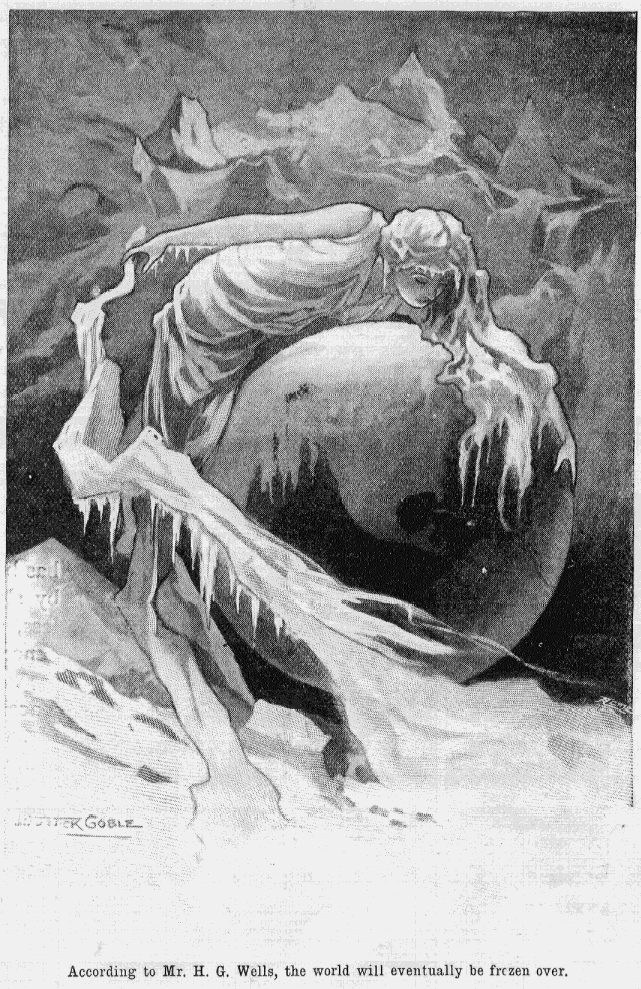
Mr. H. G. Wells has drawn in his romance, "The Time Machine," a strangely impressive picture of the end of the world as he conceives it. The last man, according to his conception, freezes to death, and life becomes unsupportable on our planet, not because of great heat, but rather from intense cold.

Mr. Wells has the testimony of science on his side. and has indeed based his assumptions on the learned treatises of Professor J.H. Darwin.

By dint of laborious calculation it has been shown that the sun's heat is by slow degrees becoming less and less, and that some day, long years hence, the sun will no longer give out the warmth necessary for human existence. Mounting his "time machine," Mr. Wells plunges off into the future, and, when he has journeyed millions of years hence, he finds a slowly freezing world in which man and beast fail to find the means of subduing the pangs of hunger or of protecting themselves from the cold. The sun hangs in a grey sky -- a pale, weird, ash-coloured ball, incapable of supplying light and warmth.

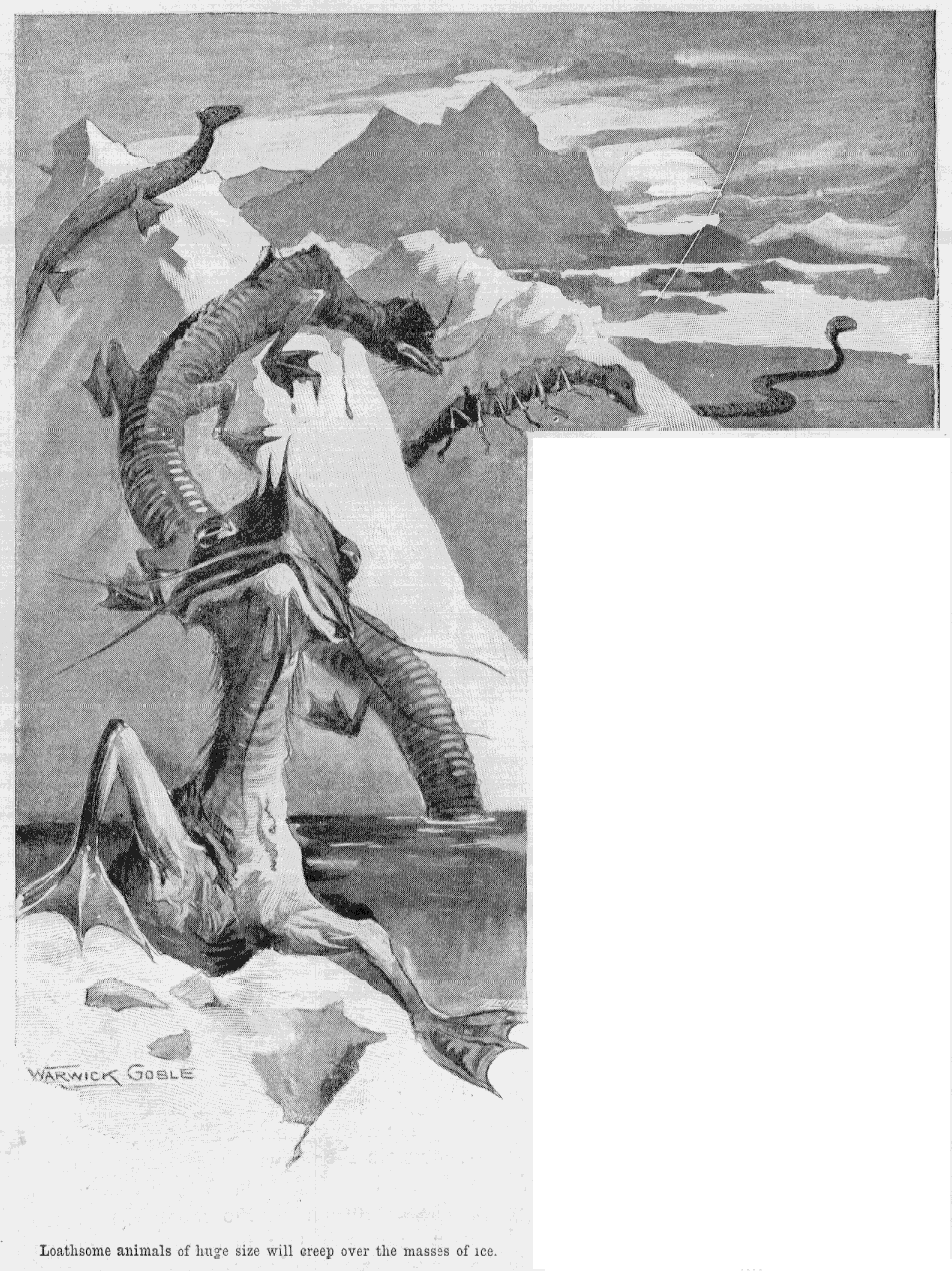
Loathsome animals of huge size, brought into existence by the altered condition of affairs, creep over the masses of ice and crawl over the frozen seas and lakes. Little by little all trace of vegetation disappears -- a steady snowstorm settles down over the earth, and our planet revolves in space for a short time only to fall a frozen mass into the bosom of the dying sun.

That the solar temperature is declining is, I think, universally conceded by astronomers, who also admit the steady contraction of our great luminary. The sun is now apparently contracting at the rate of 220 feet per annum, and if we look forward through a vista of many thousands of years we see the sun ever diminishing in dimensions. There is, however no cause for immediate alarm, and millions of years must elapse before our sun will have vanished from the heavens.

Looking back at the past history of the earth the astronomer pictures a time when the earth was a sun. Coming down the ages he shows us a globe whose condition resembles that of Jupiter and Saturn, planets at the present time with dense atmospheres still loaded with the waters which are to form their future oceans. Peering into the future he recognises in the moon's actual condition a stage through which our planet will assuredly have to pass.

The earth's inherent heat must pass away, the life on her surface slowly disappear, until she becomes made up, as we believe the moon to be, of desert continents and frost bound oceans, lifeless as at the beginning of her history, but no longer -- as Mr. Proctor put it -- "possessing that potentiality of life which existed in her substance before life appeared upon her surface. Long as has been, and doubtless will be, the duration of life upon the earth, it seems less than a second of time compared with those two awful time-intervals, one past, when as yet life had not begun; the other still to come, when all life shall have passed away."

There are writers who combat the theory that all orbs in space tend towards death and declare that this seeming tendency will be counterbalanced by some restorative forces.

Scientific men, however, reply that they are at present unaware of any such forces, and that in the light of their present knowledge every sun and every planet must be slowly yet surely wasting away.

Reference has been made to the possible annihilation of our planet by some dire catastrophe. One of the supporters of this theory is Professor Falb, a well-known astronomer, who prophesied the destruction of the world on November 13th, 1899, through collision with a comet known as Biela's. On the 29th of October, 1899, came a telegram from Santiago, Chili, announcing that Biela's comet had been observed from there and was visible to the naked eye. This announcement following on Prof. Falb's prophecy actually caused no little dismay among the poorer classes of the Continental peasantry, though in England and America little alarm was felt. Needless to state, the 13th of November came and went without the occurrence of any untoward event.

This is not the first time that this particular comet has been credited with being the instrument by which the Creator was to bring to a conclusion the existence of mankind on earth.

Between 1828 and 1832 it was generally prophesied that Biela's comet would come into collision with the earth during the latter year (the year of its first return after discovery), and there is reason to believe that a good deal of alarm was caused by such assertions.

The history of this comet may be told in a few words. On February 27th, 1826, M. Biela, in Bohemia, discovered a faint comet whose orbit -- or path round the sun -- was traversed, he calculated, in about six and three-quarter years. It was found that in 1832 this comet would pass within 20,000 miles of the earth's orbit; but, as the earth would not reach that particular point till one month after the comet had passed it, no danger to the world need have been apprehended. The assurances of the astronomer failed, however, to satisfy the minds of many ignorant and unscientific persons who pretended to be greatly alarmed at the imminent destruction of our planet.

Astronomers predicted that Biela's comet would be visible at intervals of six and three-quarter years. It returned regularly up to 1846, when it appeared divided into two distinct comets. Such a celestial apparition had never been observed before, and astronomers viewed it with the keenest interest and excitement. On January 14th the distance between the two bodies was 177,000 miles, and this was increased on February 23rd to 191,000. On the 22nd of April the comets had disappeared.

In 1852 they returned, and the distance between them now was 1,624,000 miles, and, as neither contained a proper "nucleus," it was decided that they were in process of disintegration. Since 1852 the two comets have never been seen again, and since 187 Biela's comet has not been seen, and astronomers conclude that it must have undergone the fate of all comets which approach the sun frequently and nearly -- they either fall into its vast mass and are consumed like moths around a candle, or else they waste their substance in forming tails of such extreme length that they become so attenuated as to be no longer visible.

But, the reader may ask, are there not other comets against which the earth is likely to collide with disastrous consequence to herself and to her inhabitants ? It is estimated that there are about 17,500,000 comets in connection with the solar system alone. Is it not possible that any of these may come into contact with the earth?

In 1832, our planet is known to have actually passed through the tails of comets, hut nothing came of it. What would happen if we unfortunately encountered the actual nucleus of one is a question more easily asked than answered.

Such a catastrophe, though possible, is exceedingly remote, however. Another question now arises: may not the extinction of the human race be brought about by some lower order usurping dominion over and finally destroying mankind ?

At first sight the idea seems absurd. Man, the lord of creation, to be driven off the globe by the creatures over whom he has so long held dominion! Preposterous! Let us see what science has to say to this.

Countless ages ago in the world's past history there was a time when huge monsters, both on land and sea, were common. These reigned supreme for a time, only to succumb at length and disappear. Many species even within our own time have become extinct; can man then always hope to have the preeminence?

"When once a type is gone," said the late Mr. J. F. Nesbit, "Nature never renews it. So infinite are her resources that no pattern, no number of patterns, matters. And it may be that man, a late arrival, is destined to a far shorter use of the earth than the cockroach or the lobster."

Not over flattering to human vanity, but nevertheless true!

It is conceivable that changes of climate, and gradual developments and modifications of which we know little, might concur in bringing some land species into dangerous prominence.

The vivid imagination of Mr. H. G. Wells, ever ready -- like the fat boy in Pickwick - to make our flesh creep, once pictured a world devoured hy ants! We have all read of the migratory ants of Central Africa, against which no man can stand. On the march they swiftly clear out whole villages, drive men and animals before them in headlong rout, and kill and eat every living creature they can capture.

At present they are kept under by animals which prey on them, but supposing these checks to be removed!

We know how easy it is to disturb Nature's balance; rabbits introduced thoughtlessly into Australia and Californlia rapidly became a serious pest; sparrows have in many cases brought ruin to the farmers; hyacinths, planted in Florida rivers, so multiplied that navigation soon became impossible.

Nature, again unassisted by man, sometimes produces what we call plagues of certain species. Must we then not allow the possibility of the extinction of man by the enormous increase and spread of a lower order?

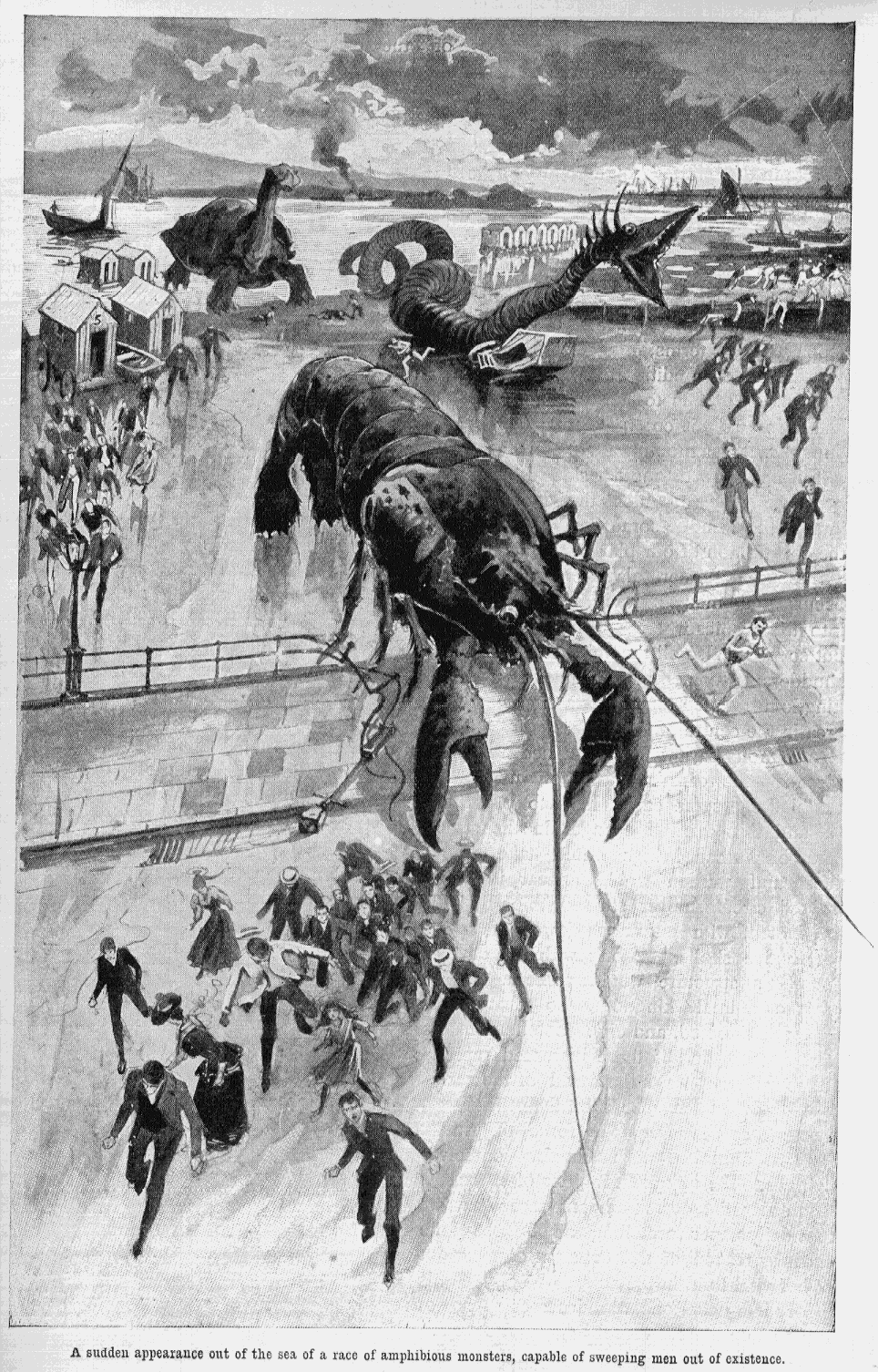
If the reader be still unconvinced let him turn to Mr. Wells' picture of the sudden appearance out of the sea of a race of amphibious monsters, capable of sweeping man and all his contrivances out of existence.

Fossil remains of crabs, 6ft. in length, have been discovered, and such enormous creatures might -- owing to some cause or other -- multiply exceedingly.

If we imagine a shark that could raid out upon the land, or a tiger that could take refuge in the sea, we should have a fair suggestion of what a terrible monster a large predatory crab might prove. And, so far as zoological science goes, we must, at least, admit that such a creation is an evolutionary possibility.

Then there are the cuttlefish, the octopus, and other denizens of the deep, any of which might conceivably grow in numbers, and extinguish man. And even if we escape death from monsters, there is the chance of our falling victims to those invisible enemies. the insidious microbes.

At present, it is true, conditions do not favour their rapid spread, but some radical change in the climate might flood the world with death-dealing micro-organisms. The fact is, we know little about the origin of diseases, and why at certain seasons certain epidemics arise.

The bacillus of plague, of influenza, of cholera, of typhoid, or any other disease propagated by germs, finds that the climatic or atmospheric conditions are favourable, and promptly proceeds to multiply, and, once it had a free run, it could destroy the entire human race in a month.

Turning now to another side of the question, we may consider the condition of man in the event of some radical change in the constitution of our planet. Suppose another glacial epoch should occur, would man survive ? He might retreat into the tropics where ice has never been; but so would also all the animal life, and one shudders to contemplate the entire animal kingdom huddled together in a circumscribed area in the centre of the earth.

A famous savant has imagined that the force of the earth's gravitation might be doubled by some cause hitherto undreamt of, and that marked changes in the structure of human beings would take place. Men and women would appear in these altered circumstances stunted, thick-limbed, flat-footed, with enormous jaws underlying diminutive skulls. Along with the change in man's structure would come a change in the animal kingdom, so that four-footed, six-footed, and eight-footed monsters would arise, and if these increased rapidly, they would soon rid the world of their two- footed adversaries. Or, if on the other hand, through some cause, the force of gravity were to diminish, we might find ourselves flying into the unknown regions of space!

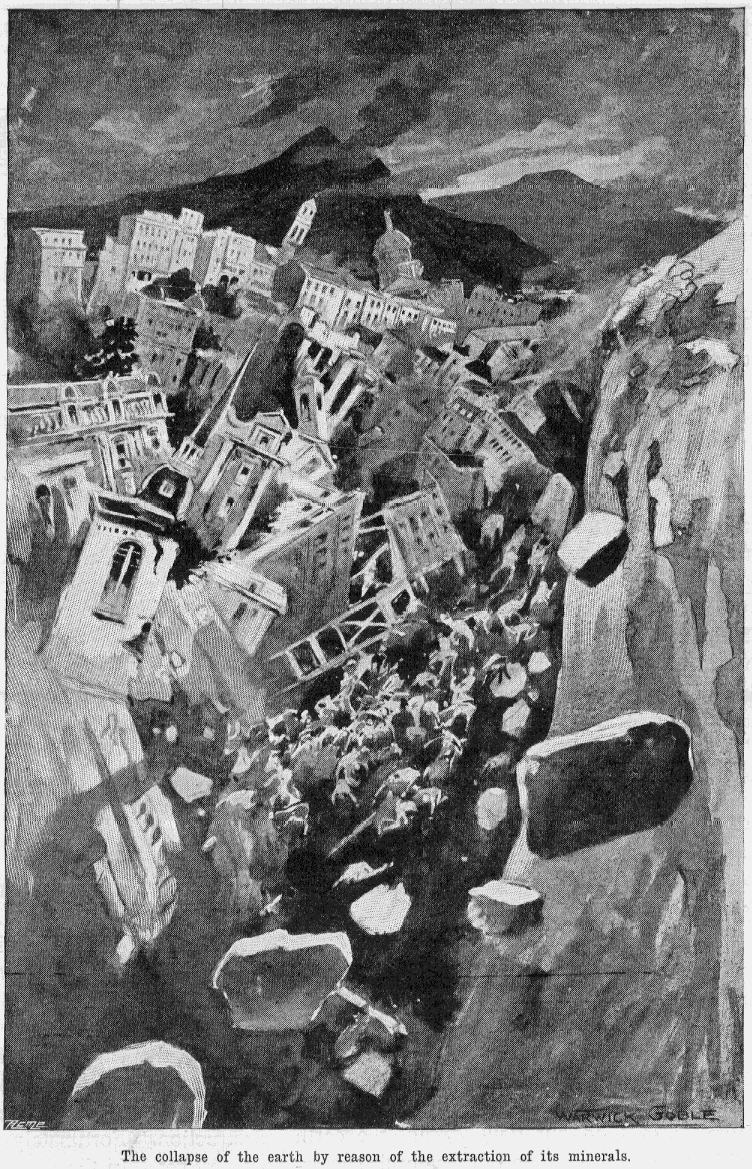
An alarmist correspondent recently wrote to a daily paper foretelling the collapse of the earth by reason of the constant drawing out of her vital fluid in the shape of -- oil! This theory is a novel one, and deserves a word of explanation here. According to the writer, the interior of the earth is liquid oil, and if this is drawn out the outside crust must give way. Each country, urges the terror-stricken individual, should pass a law constituting it a criminal offence to draw a drop of liquid oil out of the earth.

In his imagination he sees cities and towns engulfed in vast chasms, and mountains shifted from their bases, while millions of human beings, old, young, rich, and poor, each with their different lamps, are marching on to destruction, sitting by their funeral pyre, the burning lamp, while smoke, fire, darkness, horror, confusion, cover the face of all things. Truly, a dire disaster, but one which we cannot take quite seriously.

According to a French savant, M. de Lapparent, man will finally disappear from the globe because, in 4,000,000 years, the rivers and seas will have completely washed away all solid land. Man, however, is an adaptive creature, and may escape extinction by assuming the shape and nature of a fish.

Lastly, the extinction of the human race by starvation or by thirst may be considered. Sir William Crookes recently startled civilised nations by affirming that in 1931--just thirty-one years from this present year of grace 1900--there will not be enough wheat to supply the needs of the bread eaters of the world. The failure of our food supply is a calamity too awful to contemplate, and the prospect of mankind slowly dying from starvation is calculated to plunge into the depths of despair the cheeriest optimist that ever lived.

It may be interesting to mention the reasons which led Sir William Crookes to prophesy that in thirty-one years from now the world will not be able to produce enough bread for man's needs.

He argued thus:

In 1871 the bread-eaters of the world mumbered ... 371,000,000
In 1881 the bread-eaters of the world numbered ... 416,000,000
In 1891 the bread-eaters of the world numbered ... 472,600,000
In 1898 the bread-eaters of the world numbered ... 516,500,000
In 1931 the bread-eaters of thc world will number . 746,500,000
The augumentation of the world's bread-eating population in a geometrical ratio is evinced by the fact that the yearly aggregates grow progressively larger. In the early seventies they rose 4,300,000 per annum. In the eighties they increased by more than 6,000,000 per annum, necessitating annual additions to the bread supply nearly one half greater than sufficed twenty-five years ago.

To supply 516,500,000 bread-eaters in 1898 required 2,324,000,000 bushels of wheat; to supply 746,600,000 in 1931 will require 3,357,000,000 bushels.

Should all the wheat-growing countries add to their area to the utmost capacity, on the most careful calculation the yield would give us only an addition of some 100,000,000 acres, supplying at the average world-yield of 12.7 bushels to the acre, 1,270,000,000 bushels. Adding 2,324,000,000 to 1,270,000,000 we get 3,594,000,000 bushels, or just enough to supply the increase of population among bread-eaters till the year 1931.

While these lines were being written, the writer chanced upon a paper in a German magazine, by Dr. Albert Battandier, on the absorbing topic: "Is the world nearing starvation ?"

The raison d'etre of this article was a statement by a Belgian statistician, General Brialmont, that in less than 180 years the population of the globe would be so dense that the earth could no longer nourish its inhabitants, and that hundreds of millions of human beings must die yearly of hunger.

General Brialmont, though he postpones the evil day, agrees with Sir William Crookes as to the failure of the world's food supply sooner or later, if things go on as they are doing at present.

"It is the chemist," says Sir Wiiliam Crookes, "who must come to the rescue of the threatened communities. It is through the laboratory that starvation may ultimately be turned into plenty."

Since by the year 1931 the area of cultivation can be no further extended, the farmer must endeavour to raise the average yield per acre. If atmospheric nitrogen could only be made generally available as manure in accordance with Nikola Tesla's great scheme, then the ground might be made to bear twice as large crops as it does at present.

Then there is the view, held by many eminent natural philosophers, that in the near Iuture the chemist will produce food artificially in his laboratory, thus rendering the tilling of the soil no longer a necessary labour.

M. Berthelot, the great French chemist, is an ardent supporter of this theory. According to him bread, meat, vegetables, etc., will some years hence be only a distant memory, and a dinner menu will be made up as follows:--

A small tablet of nitrogenous matter.
Pastilles of fatty material.
A little sugar.
A little seasoning.
"And then," exclaims the enthusiast," when the nourishment of man is no longer a daily problem, when we are no longer forced to ask humbly of God our daily bread, the earth will become a vast garden, natural subterranean streams will rise to the surface, and the human race will live in the legendary abundance of the Golden Age."

Others might be apt to view a world like this as a very dull place for mortals. Still, one might get used to tablets and pastilles in time.

As to the death of man from thirst a word must be said. The originator of this theory is M. X. Stanier, Professor of Geology at the Agricultural Institute of Gembloux.

M. Stanier allows that the idea of mankind dying from thirst seems paradoxical when we consider the seemingly inexhaustible supplies man possesses in the oceans and seas which cover three-quarters of the surface of the globe. Still, there is some danger of this vast quantity disappearing. In the past the terrestrial crust, says M. Stanier, has absorbed large quantities of water; this action is always going on, and is likely to assume greater proportions in the future. On account of its weight water tends to descend into deep holes; while the centre of the globe remains in a fiery condition this absorption is slow, but as the cooling of the interior goes on, the surface water will penetrate more and more, and will enter into combination with the recently solidified rocks in the heart of the earth, which are specially absorptive by reason of their metallic composition.

"The oceans," prophesies M. Stanier, " will grow smaller and smaller; the rains which nourish the continents will become rarer and rarer, while the deserts will enlarge their boundaries and gradually absorb the fertile plains."

In order the better to point his moral, M. Stanier asks us to consider the planet Mars, the inhabitants of which are slowly dying from want of water. What were formerly supposed to be Martian seas are, on the contrary (so M. Stanier would have us believe), nothing but immense arid plains.

"One stage more, and all life will have disappeared on the planet Mars."

These, then, are some of the predictions as to the end of the world. Whichever of these may come true, man seems doomed to destruction. Fortunately the evil is a long way off yet. In the meantime let us take for our motto these fine lines:

"Like the star
Which shines afar,
Without haste,
Without rest;
Let each man wheel,
With steady sway,
Round the task
Which rules the day,
And do his best."


 Herbert C. Fyfe, How Will The World End? Pearson's Magazine, July 1900


lunes, 16 de enero de 2023

LA FIN PROCHAINE DU GENRE HUMAIN (1831)


"On parle beaucoup de l'amélioration de l'espèce humaine et de sa destinée progressionnelle; on ne parle jamais de sa fin. C'est une erreur qui caractérise singulièrement la vanité de l'homme que de croire  la race d'Adam immortelle au milieu de tout ce qui meurt, et d'imaginer que le principe  de destruction qui mine les soleils ménagera respectueusement l'organisation du triste quadrupède vertical auquel appartient maintenant l'empire du monde. Si on vient vous parler en philosophe ou en théologien de la  dernière catastrophe du globe, voilà tout à  coup la catastrophe des dernières familles qui se figure à votre pensée; des peuples luttant contre l'invasion d'un déluge ou d'un incendie; des femmes qui gémissent en emportant leurs nouveau-nés dans leurs bras; des vieillards qui reprochent à l'univers son empressement à mourir, parce qu'ils avoient, eux, quelques jours à vivre encore. J'aime à croire, si notre planète vit âge de planète, que cela ne sera pas si tragique, au moins pour notre noble race d'anthropomorphes, dont la durée générique est loin d'être essentiellement mesurée sur celle d'une sphère minérale de neuf mille lieues de circonférence. A moins d'accident, car les planètes n'en sont pas exemptes, il y aura longtemps alors que des espèces nouvelles s'amuseront à recomposer de débris fossiles le squelette de l'homme, et à lui chercher une place convenable à côté de ceux du singe et de la chauve-souris. C'est la marche de la nature; il n'y a rien à y faire.

Je me souviens peu de ce que je savois de philosophie physique et d'histoire naturelle quand je croyois savoir quelque chose; mais il me semble qu'il y a des principes si rationnels dans les sciences de faits qu'on peut mettre les académies au défi d'y rien changer. Ceux-là sont tels que vous avez le droit de les convertir en axiomes, et de leur imprimer le même sceau d'infaillibilité qu'à une addition de deux chiffres exactement faite. J'en rapporterai quelques-unes pour prouver à quel point cette proposition est naïve; j'ai peur qu'elle ne le soit trop.

Et d'abord les corps les plus simplement organisés sont les plus durables.

Et secondement les premières combinaisons élémentaires qui aient produit l'être ont été les plus simples.

Et troisièmement, à mesure que les élaborations permanentes de l'agent créateur se compliquent, elles perdent en vitalité ce qu'elles gagnent en perfection.

Et voilà pourquoi les huîtres de Lucrin, si estimées d'Apicius, seront probablement belles encore, et vermeilles, et succulentes, quand elles n'auront plus à redouter depuis des siècles, dans la race d'Apicius, le plus insatiable des animaux ostréophages.

Et voilà pourquoi les algues de la mer verront finir des générations de coquillages; et les rochers qu'elles embrassent des générations de plantes marines; et le monde ses rochers dissous; et le tourbillon ses mondes, et l'infini ses tourbillons.

Tout passe du simple au composé en s'enrichissant graduellement de nouvelles acquisitions organiques, et tout retourne du composé au simple pour lui rendre ses éléments.

Ainsi une existence complète c'est une existence qui commence à mourir.

Les développements d'une existence complète ont cependant des limites inconnues devant lesquelles ils reculent tout à coup comme la sève du chêne ou le vol du condor; et ce qui est vrai des individus après soixante siècles d'observation est également vrai des espèces. Au moins faut-il convenir que cette induction est universellement reçue, car il n'y a point d'autre preuve de la mort.

Autrement, si l'on admettoit la perfectibilité indéfinie des espèces, qui n'est qu'une théorie, et que l'on ne contestât pas la décadence indéfinie des espèces, qui est un fait, ce seroit l'huître qui finiroit par manger Apicius.

Il n'y a qu'un moyen de défendre le système de la perfectibilité humaine; c'est de faire intervenir au dénouement de la discussion la machine tragique des Grecs, un dieu. Alors le paradoxe change de nom, il devient dogme, et je ne m'en mêle plus. Vous en savez plus que la science, et je ne suis pas même
 savant.

Sous l'aspect philosophique et scientifique de la question, et je ne vois pas sous quel autre aspect on oseroit la considérer aujour-d'hui, elle va se réduire presque à rien :

Les espèces finissent; donc l'espèce homme doit finir.

Elles finissent après avoir accompli les conditions possibles de leur développement; reste-t-il à l'homme des conditions possibles de développement à remplir?

S'il ne lui en reste plus, quelles sont les marques de sa décadence, et à quel âge en est-il arrivé? Voilà ce que je voudrois éclaircir en m'affranchissant de ce fatras technique des méthodes où l'on retombe toujours malgré soi quand on a eu le malheur de lire. (...) 

Voici l'homme, résultat culminant d'une œuvre de providence ou de hasard; l'homme soumis à toutes les vicissitudes du temps, qui altère, qui détruit, qui décompose tout; et condamné à les subir avec plus de promptitude et d'intensité en raison même de la complication de ses organes et du pouvoir de son intelligence; l'homme presque aussi vital que les anges, et moins vivace que les reptiles. C'est la condition essentielle de sa supériorité.

A lui finit, selon vous, l'échelle ascendante de l'organisation animale; il ne lui reste plus qu'à descendre vers la mort.

La religion seule a le droit de supposer qu'il étoit réservé à une autre destination; elle l'a fait, mais en reconnoissant qu'il l'avoit perdue, tant se manifestoient déjà sensiblement les progrès de sa dégénération inévitable, au temps des premières religions écrites! Ainsi, aux yeux du chrétien comme aux yeux du philosophe, l'espèce est appelée à mourir de mort; car ce n'est pas au père des hommes lui seul que s'est adressée cette terrible et profonde révélation de Dieu; ce n'est pas seulement à chacun de ses descendants pris dans son individualité mortelle : c'est à tout le genre humain, qui doit aussi mourir un jour comme un seul homme.

Ce phénomène de la destruction des êtres au bout d'un certain période n'étoit plus un nouveau mystère, selon toute apparence, dès le sixième des grands jours de la création. La terre avoit dû voir se renouveler plusieurs fois et les animaux qui la parcourent, et les plantes qui la décorent. La demeure de l'homme naissant étoit le tombeau d'une multitude d'existences qu'Adam ne put nommer dans le Paradis terrestre, parce qu'elles avoient cessé d'être avant qu'il fût. Sous ses pieds gisoient, réunies à l'humus reproducteur, ces immenses forêts de juncacées gigantesques, et restituées en fossiles à la forme minérale de la matière, ces familles de sauriens incommensurables qui livrent encore aujourd'hui à l'investigation du savant les vestiges authentiques de plusieurs créations successivement rendues au foyer des créations éternelles.

(...)  Les premières générations d'hommes, qui duroient longtemps et qui avoient des loisirs pour observer, parce que la terre n'étoit pas encore une arène- c'étoit toujours un spectacle-ne tardèrent pas sans doute à reconnoître, sous l'œuvre annuelle des reproductions, le travail sourd et permanent de la destruction, qui modifie, oblitère, transforme tout, et puis fait tout disparoître à son jour. (...) Une tradition perpétuée d'âge en âge, et qui subsiste encore dans leurs livres sacrés, entretenoit chez eux le souvenir du béhémoth et du léviathan, ces colosses du monde vivant, et celui du griffon au bec et au vol d'aigle, qui avoit quatre pieds de lion. Dans la race même de l'homme, elles purent déjà observer une déclivité menaçante. Ce ne furent bientôt plus ces géants millénaires dont il est question dans toutes les histoires, et dont tant de monuments presque indestructibles attestent la puissance. Leur mission d'ascendant et de conquête s'étoit accomplie en peu de temps, soit qu'il entre dans l'essence des espèces jeunes d'épuiser rapidement, en luxe inutile, le feu surabondant qui les vivifie, soit qu'il ait convenu à Dieu de hâter sous les regards de sa seule créature raisonnante les scènes qui pouvoient lui faire comprendre le secret de son organisation et de sa décadence. Il est probable qu'il ne fut pas question alors de la perfectibilité indéfinie de la race humaine. Ce ridicule étoit réservé à des nains de cinq pieds entassés dans des cloaques odieux pour souffrir et pour mourir, et qui expirent tout caducs, à soixante ans, dans une atmosphère de sang et de boue, sur la page où ils délaient dans quelques gouttes d'encre ce dernier mensonge de la vanité.

Il n'y a plus de sophismes dans tout cela; car, à force de nous rapprocher de la matière et d'y chercher notre origine, nous y avons trouvé du moins les ruines de ce qui étoit avant nous. Il n'y a point de dendrite qui ne conserve l'empreinte d'une plante inconnue. Vous verrez des fleurs enchâssées dans le cristal laiteux de l'agathe, comme le bouquet merveilleux de la fiancée d'un génie. Ce sable que vous roulez sous vos pieds et qui étincelle de reflets de nacre, ce sont les débris d'un nautile qui n'est plus; celui-là qui se maintient en disques solides et dorés, parce qu'il s'est revêtu, comme les courtisans habiles qui savent survivre aux révolutions, de la couche la plus solide des métaux, c'est un ammonite dont l'espèce est perdue.

Et puis cherchez ce qui adviendra de l'espèce humaine tout entière: un sable à rouler sous les pieds!...


Charles Nodier, LA FIN PROCHAINE DU GENRE HUMAIN (1831)

viernes, 29 de abril de 2022

Edgardo and Selina

CHAPTER I.


The sun was setting over Sloperton Grange, and reddened the window of the lonely chamber in the western tower, supposed to be haunted by Sir Edward Sedilia, the founder of the Grange. In the dreamy distance arose the gilded mausoleum of Lady Felicia Sedilia, who haunted that portion of Sedilia Manor, known as "Stiff-uns Acre." A little to the left of the Grange might have been seen a mouldering ruin, known as "Guy's Keep," haunted by the spirit of Sir Guy Sedilia, who was found, one morning, crushed by one of the fallen battlements. Yet, as the setting sun gilded these objects, a beautiful and almost holy calm seemed diffused about the Grange.

The Lady Selina sat by an oriel window, overlooking the park. The sun sank gently in the bosom of the German Ocean, and yet the lady did not lift her beautiful head from the finely curved arm and diminutive hand which supported it. When darkness finally shrouded the landscape she started, for the sound of horse-hoofs clattered over the stones of the avenue. She had scarcely risen before an aristocratic young man fell on his knees before her.

"My Selina!"

"Edgardo! You here?"

"Yes, dearest."

"And--you--you--have--seen nothing?" said the lady in an agitated voice and nervous manner, turning her face aside to conceal her emotion.

"Nothing--that is nothing of any account," said Edgardo. "I passed the ghost of your aunt in the park, noticed the spectre of your uncle in the ruined keep, and observed the familiar features of the spirit of your great-grandfather at his usual post. But nothing beyond these trifles, my Selina. Nothing more, love, absolutely nothing."

The young man turned his dark liquid orbs fondly upon the ingenuous face of his betrothed.

"My own Edgardo!--and you still love me? You still would marry me in spite of this dark mystery which surrounds me? In spite of the fatal history of my race? In spite of the ominous predictions of my aged nurse?"

"I would, Selina"; and the young man passed his arm around her yielding waist. The two lovers gazed at each other's faces in unspeakable bliss. Suddenly Selina started.

"Leave me, Edgardo! leave me! A mysterious something--a fatal misgiving--a dark ambiguity--an equivocal mistrust oppresses me. I would be alone!"

The young man arose, and cast a loving glance on the lady. "Then we will be married on the seventeenth."

"The seventeenth," repeated Selina, with a mysterious shudder.

They embraced and parted. As the clatter of hoofs in the court- yard died away, the Lady Selina sank into the chair she had just quitted.

"The seventeenth," she repeated slowly, with the same fateful shudder. "Ah!--what if he should know that I have another husband living? Dare I reveal to him that I have two legitimate and three natural children? Dare I repeat to him the history of my youth? Dare I confess that at the age of seven I poisoned my sister, by putting verdigris in her cream-tarts,--that I threw my cousin from a swing at the age of twelve? That the lady's-maid who incurred the displeasure of my girlhood now lies at the bottom of the horse- pond? No! no! he is too pure,--too good,--too innocent, to hear such improper conversation!" and her whole body writhed as she rocked to and fro in a paroxysm of grief.

But she was soon calm. Rising to her feet, she opened a secret panel in the wall, and revealed a slow-match ready for lighting.

"This match," said the Lady Selina, "is connected with a mine beneath the western tower, where my three children are confined; another branch of it lies under the parish church, where the record of my first marriage is kept. I have only to light this match and the whole of my past life is swept away!" she approached the match with a lighted candle.

But a hand was laid upon her arm, and with a shriek the Lady Selina fell on her knees before the spectre of Sir Guy.


CHAPTER II.


"Forbear, Selina," said the phantom in a hollow voice.

"Why should I forbear?" responded Selina haughtily, as she recovered her courage. "You know the secret of our race?"

"I do. Understand me,--I do not object to the eccentricities of your youth. I know the fearful destiny which, pursuing you, led you to poison your sister and drown your lady's-maid. I know the awful doom which I have brought upon this house! But if you make way with these children--"

"Well," said the Lady Selina, hastily.

"They will haunt you!"

"Well, I fear them not," said Selina, drawing her superb figure to its full height.

"Yes, but, my dear child, what place are they to haunt? The ruin is sacred to your uncle's spirit. Your aunt monopolizes the park, and, I must be allowed to state, not unfrequently trespasses upon the grounds of others. The horse-pond is frequented by the spirit of your maid, and your murdered sister walks these corridors. To be plain, there is no room at Sloperton Grange for another ghost. I cannot have them in my room,--for you know I don't like children. Think of this, rash girl, and forbear! Would you, Selina," said the phantom, mournfully,--"would you force your great-grandfather's spirit to take lodgings elsewhere?"

Lady Selina's hand trembled; the lighted candle fell from her nerveless fingers.

"No," she cried passionately; "never!" and fell fainting to the floor.


CHAPTER III


Edgardo galloped rapidly towards Sloperton. When the outline of the Grange had faded away in the darkness, he reined his magnificent steed beside the ruins of Guy's Keep.

"It wants but a few minutes of the hour," he said, consulting his watch by the light of the moon. "He dare not break his word. He will come." He paused, and peered anxiously into the darkness. "But come what may, she is mine," he continued, as his thoughts reverted fondly to the fair lady he had quitted. "Yet if she knew all. If she knew that I were a disgraced and ruined man,--a felon and an outcast. If she knew that at the age of fourteen I murdered my Latin tutor and forged my uncle's will. If she knew that I had three wives already, and that the fourth victim of misplaced confidence and my unfortunate peculiarity is expected to be at Sloperton by to-night's train with her baby. But no; she must not know it. Constance must not arrive. Burke the Slogger must attend to that.

"Ha! here he is! Well?"

These words were addressed to a ruffian in a slouched hat, who suddenly appeared from Guy's Keep.

"I be's here, measter," said the villain, with a disgracefully low accent and complete disregard of grammatical rules.

"It is well. Listen: I'm in possession of facts that will send you to the gallows. I know of the murder of Bill Smithers, the robbery of the tollgate-keeper, and the making away of the youngest daughter of Sir Reginald de Walton. A word from me, and the officers of justice are on your track."

Burke the Slogger trembled.

"Hark ye! serve my purpose, and I may yet save you. The 5.30 train from Clapham will be due at Sloperton at 9.25. IT MUST NOT ARRIVE!"

The villain's eyes sparkled as he nodded at Edgardo.

"Enough,--you understand; leave me!"


CHAPTER IV.


About half a mile from Sloperton Station the South Clapham and Medway line crossed a bridge over Sloperton-on-Trent. As the shades of evening were closing, a man in a slouched hat might have been seen carrying a saw and axe under his arm, hanging about the bridge. From time to time he disappeared in the shadow of its abutments, but the sound of a saw and axe still betrayed his vicinity. At exactly nine o'clock he reappeared, and, crossing to the Sloperton side, rested his shoulder against the abutment and gave a shove. The bridge swayed a moment, and then fell with a splash into the water, leaving a space of one hundred feet between the two banks. This done, Burke the Slogger,--for it was he,--with a fiendish chuckle seated himself on the divided railway track and awaited the coming of the train.

A shriek from the woods announced its approach. For an instant Burke the Slogger saw the glaring of a red lamp. The ground trembled. The train was going with fearful rapidity. Another second and it had reached the bank. Burke the Slogger uttered a fiendish laugh. But the next moment the train leaped across the chasm, striking the rails exactly even, and, dashing out the life of Burke the Slogger, sped away to Sloperton.

The first object that greeted Edgardo, as he rode up to the station on the arrival of the train, was the body of Burke the Slogger hanging on the cow-catcher; the second was the face of his deserted wife looking from the windows of a second-class carriage.


CHAPTER V.


A nameless terror seemed to have taken possession of Clarissa, Lady Selina's maid, as she rushed into the presence of her mistress.

"O my lady, such news!"

"Explain yourself," said her mistress, rising.

"An accident has happened on the railway, and a man has been killed."

"What--not Edgardo!" almost screamed Selina.

"No, Burke the Slogger!" your ladyship.

"My first husband!" said Lady Selina, sinking on her knees. "Just Heaven, I thank thee!"


CHAPTER VI.


The morning of the seventeenth dawned brightly over Sloperton. "A fine day for the wedding," said the sexton to Swipes, the butler of Sloperton Grange. The aged retainer shook his head sadly. "Alas! there's no trusting in signs!" he continued. "Seventy-five years ago, on a day like this, my young mistress--" But he was cut short by the appearance of a stranger.

"I would see Sir Edgardo," said the new-comer, impatiently.

The bridegroom, who, with the rest of the wedding-train, was about stepping into the carriage to proceed to the parish church, drew the stranger aside.

"It's done!" said the stranger, in a hoarse whisper.

"Ah! and you buried her?"

"With the others!"

"Enough. No more at present. Meet me after the ceremony, and you shall have your reward."

The stranger shuffled away, and Edgardo returned to his bride. "A trifling matter of business I had forgotten, my dear Selina; let us proceed." And the young man pressed the timid hand of his blushing bride as he handed her into the carriage. The cavalcade rode out of the court-yard. At the same moment, the deep bell on Guy's Keep tolled ominously.


CHAPTER VII.


Scarcely had the wedding-train left the Grange, than Alice Sedilia, youngest daughter of Lady Selina, made her escape from the western tower, owing to a lack of watchfulness on the part of Clarissa. The innocent child, freed from restraint, rambled through the lonely corridors, and finally, opening a door, found herself in her mother's boudoir. For some time she amused herself by examining the various ornaments and elegant trifles with which it was filled. Then, in pursuance of a childish freak, she dressed herself in her mother's laces and ribbons. In this occupation she chanced to touch a peg which proved to be a spring that opened a secret panel in the wall. Alice uttered a cry of delight as she noticed what, to her childish fancy, appeared to be the slow-match of a fire- work. Taking a lucifer match in her hand she approached the fuse. She hesitated a moment. What would her mother and her nurse say?

Suddenly the ringing of the chimes of Sloperton parish church met her ear. Alice knew that the sound signified that the marriage party had entered the church, and that she was secure from interruption. With a childish smile upon her lips, Alice Sedilia touched off the slow-match.


CHAPTER VIII.


At exactly two o'clock on the seventeenth, Rupert Sedilia, who had just returned from India, was thoughtfully descending the hill toward Sloperton manor. "If I can prove that my aunt Lady Selina was married before my father died, I can establish my claim to Sloperton Grange," he uttered, half aloud. He paused, for a sudden trembling of the earth beneath his feet, and a terrific explosion, as of a park of artillery, arrested his progress. At the same moment he beheld a dense cloud of smoke envelop the churchyard of Sloperton, and the western tower of the Grange seemed to be lifted bodily from its foundation. The air seemed filled with falling fragments, and two dark objects struck the earth close at his feet. Rupert picked them up. One seemed to be a heavy volume bound in brass.

A cry burst from his lips.

"The Parish Records." He opened the volume hastily. It contained the marriage of Lady Selina to "Burke the Slogger."

The second object proved to be a piece of parchment. He tore it open with trembling fingers. It was the missing will of Sir James Sedilia!


CHAPTER IX.

When the bells again rang on the new parish church of Sloperton it was for the marriage of Sir Rupert Sedilia and his cousin, the only remaining members of the family.

Five more ghosts were added to the supernatural population of Sloperton Grange. Perhaps this was the reason why Sir Rupert sold the property shortly afterward, and that for many years a dark shadow seemed to hang over the ruins of Sloperton Grange.

THE END.

Bret Harte, "Selina Sedilia, by Miss Μ. E. B-dd-n and Mrs. H-n-y W-d"
Condensed Novels

sábado, 14 de agosto de 2021

I cosmonauti di Umberto Eco


C’era una volta la terra. E c’era una volta Marte. 

Stavano molto distanti l’uno dall’altra, in mezzo al cielo e intorno c’erano milioni di pianeti e di galassie. Gli uomini che stavano sulla terra volevano raggiungere Marte e gli altri pianeti: ma erano così lontani!Comunquesi misero d’impegno. Primalanciaronodei satelliti che giravano intorno alla Terra per due giorni e poitornavano giù.Poi lanciavano dei razzi che facevano alcuni giri intorno alla Terra, ma invece ditornare giù, alla fine sfuggivano all’attrazione terrestre e partivano per lo spazio infinito.Dapprimanei razzi misero dei cani: ma i cani non sapevano parlare, e attraverso la radio trasmettevano solo «bau bau».Il cosmonauta sichiamava così perchépartiva ad esplorare il cosmo: e cioè lo spazio infinito coi pianeti, le galassie e tutto quello che ci sta intorno.Un bel mattino partirono dalla terra tre razzi.Sul primo c’era un americano che fischiettavatutto allegro un motivettojazz. Sul secondo c’era un russo che cantava con voce profonda «Volga, Volga». Sul terzo c’era un cinese che cantava una bellissima canzone, che agli altri due sembrava stonataTutti e tre volevano arrivare primi su Marte per mostrare chi era il più bravo.L’americano infatti non amava il russo e il russo non amava l’americano, e il cinese diffidavadi tutti e due.E questo perché l’americano per dire “buongiorno” diceva «how do you do»Il russo diceva: «3APABCTBYNTE». E il cinese diceva: «YJYJY!». Cosìnon si capivano e si credevano diversi.Siccometutti e tre erano bravi, arrivarono su Marte quasi nello stesso momento.Sceserodalle loro astronavi col cascoe la tuta spaziale... Trovarono un paesaggio meraviglioso e inquietante: il terreno era solcatoda lunghi canali pieni d’acqua color verde smeraldo. C’erano strani alberi blu con uccelli mai visti, dalle piumedi colore stranissimo. All’orizzonte si vedevano montagne rosse che mandavano strani bagliori.I cosmonauti guardarono il paesaggio e si guardarono l’un l’altro, e se ne stavano ciascuno in disparte, diffidando l’uno dell’altro.Poiè scesa la notte. C’era intorno uno strano silenzio, e la Terra brillava nel cielo come una stella lontana.I cosmonauti si sentivano tristi e sperduti e l’americano, nel buio, chiamò la mamma.

2Disse: «Mommy»...E il russo: «Mama.» E il cinese: «Ma-Ma.»Ma capirono subito che stavano dicendo la stessa cosa e provavano gli stessi sentimenti. Così sorrisero, si avvicinarono, accesero insieme un bel fuoco e ciascuno cantò le canzoni del suo paese. Allora si fecero coraggio e, attendendo il mattino impararono a conoscersi.Poi arrivò il mattino: faceva molto freddo. E improvvisamente da un ciuffod’alberi uscì un marziano. A vederlo era davvero orribile! Era tutto verde, aveva due antenne al posto delle orecchie, una proboscidee sei braccia.Li guardò e disse: «GRRRR!» Nella sua lingua voleva dire: «Mamma mia, chi sono quegli esseri orribili?!»Ma i terrestri non lo capirono e erano sicuri che il suo era un ruggitodi guerra. Era così diverso da loro che non erano capacidi capirlo e di amarlo. Si sentirono subito d’accordo e si schieraronocontro di lui.Di fronte aquel mostrole piccole differenze scomparivano. Che importavase parlavano un linguaggiodiverso? Capirono che erano tutti e tre esseri umani.L’altro no. Era troppo brutto e i terrestri pensavano che chi è brutto è anche cattivo.Cosìdecisero di ucciderlo con i loro disintegratoriatomici.Ma improvvisamente, nel gelodel mattino, un uccellinomarziano che era evidentemente fuggitodal nido, cadde al suolotremando di paura.Pigolavadisperato, più o meno come un uccellino terrestre. Facevadavvero pena.L’americano, il russo e il cinese lo guardarono e non seppero trattenere una lacrimadi compassione. E a quel puntoaccadde un fatto strano. Anche il marziano si avvicinò all’uccellino, lo guardò e lasciò sfuggire due filidi fumo dalla proboscide. E i terrestri, di colpo, compresero che il marziano stava piangendo. A modo suo, come fanno i marziani.Poi videro che si chinavasull’uccellino e lo sollevavatra le sue sei braccia cercando di scaldarlo.Il cinese si volsealloraai due amici terrestri “Avete capito?” disse: “noi credevamo che questo mostro fosse diverso da noi, e inveceanche lui ama gli animali, sa commuoversi, ha un cuore e certamente anche un cervello! Credete che sia ancora il caso di ucciderlo”?Non era neppure una domandada farsi. I terrestri avevano ormai capito la lezione: non bastache due creature siano diverse perché debbano essere nemiche.Perciòsi avvicinarono al marziano e gli tesero la mano.Ed egli, che ne aveva sei, strinsein una volta sola la mano a tutti e tre, mentre con quelle libere faceva gestidi saluto.E additandola terra lassùnel cielo, fece capire che desiderava farsi un viaggio, per conoscere gli altri abitanti e studiare insieme a loro il modo di fondareuna grande repubblica spaziale in cui tutti andassero d’amoree d’accordo.I terrestri dissero di sì tutti contentiE per festeggiarel’avvenimentogli offrirono una bottigliettadi acqua freschissima portata dalla terra. Il marziano tutto felice infilòil naso nella bottiglia, aspirò, e poi disse che quella bevandagli piaceva molto, anche se gli faceva girare un po’ la testa. Ma ormaii terrestri non si stupivanopi

Avevano capito che sulla Terra, come su gli altri pianeti, ciascunoha i propri gusti, ma è solo una questione di capirsi a vicenda.


Umberto Eco, I tre cosmonauti

domingo, 18 de julio de 2021

Les voyages temporels de Jacques Rigaut alias Palentête


Un brillant sujet

Roman


à André Breton.


Un mobile animé d’une vitesse telle qu’il fait, selon le plan de l’Équateur et dans le sens inverse à celui de la rotation de la terre, une fois le tour de cette sphère, pendant que celle-ci se serait déplacée d’une quantité négligeable, se conçoit. Avec quelques figures et une bonne réputation, il n’est pas plus difficile de représenter le temps comme une spirale que le temps absolu ou la marche du temps, et un mobile parti d’un point à midi, passerait par 6, 0, 18 heures, et arriverait au midi du jour précédent, — et la suite.

Un ingénieur divorcé construit un appareil en forme d’œuf géant, qui, par des différences de température obtenues par l’électricité et sans influencer la température de la cellule ménagée à l’intérieur de cet œuf, est propre à remonter le courant du temps. Une inquiétude subsiste : on craint que le voyageur ne rajeunisse au cours de son expédition, on craint de trouver à la première station, un nourrisson, ou, si le voyage se prolonge, le père et la mère du voyageur, et peut-être toute son ascendance comprimée dans l’appareil.

Un jeune homme sentimental — soit Palentête — veut profiter de cette invention pour refaire sa vie. Il se propose de retrouver, sept ans en arrière, une maîtresse perdue, et de recommencer cette expérience autant de fois qu’il le faudra pour obtenir un amour réussi.

Départ de Palentête, arrivée de Palentête. Il pénètre dans l’appartement de sa maîtresse : « Moi prime ! s’écrie-t-il en se trouvant en présence d’un Palentête âgé de 20 ans, couché dans le lit de sa maîtresse. J’avais imparfaitement prévu l’intégralité du passé. Je suppose qu’en emmenant le Palentête, ici présent avec moi dans mon œuf, et qu’en faisant une station chaque année, je pourrai me recueillir à mes différents âges, et me confronter dans une même pièce avec une vingtaine de mes exemplaires de toutes les tailles ».

Rivalité de Palentête et de Palentête. Palentête, fort de la connaissance de ce qui va se passer, supplante Palentête. Désespéré, Palentête menace de se suicider. Effroi de Palentête qui redoute que ce suicide n’entraîne sa mort ; il cède la place à Palentête et remonte dans son appareil.

Désireux de se dégourdir les Jambes, Palentête s’arrête 23 ans en arrière, dans le même pays. Divers incestes sont consommés. Palentête a quelques raisons de croire qu’il est son propre père.

« Napoléon, Hannibal, les Pyramides ! Zut ! Passons au déluge ! » articule Palentête en s’appliquant sur la poitrine une machine à enregistrer les battements du cœur, afin de rester capable d’évaluer son âge. Palentête part à la découverte de la Genèse.

Incertain de rencontrer Dieu et impuissant à modifier un passé dont il est issu, Palentête s’applique à en créer de nouvelles versions, juste de quoi déconcerter ceux des hommes de son époque qui s’aventureraient à sa suite dans le passé et qui risquent de ne plus rien y rencontrer de conforme à l’histoire :

A la fin du règne d’Auguste, Palentête, après avoir parcouru six mois la province de Judée, découvre un enfant, Jésus de Nazareth, endormi sous un olivier ; il lui injecte du cyanure de potasse dans les veines.

Quelques années plus loin, il guette, pendant ses promenades, une fillette d’Égypte ; un jour qu’il l’aperçoit seule, il se jette sur elle et, avec sa pince à gaz, il lui mutile le nez. Cette fillette s’appelait Cléopâtre.

Faisant halte dans l’Amérique du sud, Palentête découvre à des hommes rouges l’usage de la vapeur et de l’électricité. On l’honore comme une divinité ; sur sa demande, on lui livre chaque mois 50 filles et 50 garçons.

Palentête enseigne dans les 5 continents le dogme du suicide obligatoire à 20 ans.

Palentête dépose entre les mains d’Homère la deuxième Aventure céleste de Monsieur Antipyrine de Tristan Tzara.

Palentête s’illustre par des prophéties sous différents noms : Ezéchiel, Jérémie, Isaïe.

(...) Ses conserves alimentaires sont épuisées, Palentête est obligé de s’arrêter fréquemment. II perd plusieurs mois à jouer la comédie de la divinité, pour se faire remettre des provisions. Une barbe blanche lui cache la poitrine. De vieillesse, Palentête meurt dans son œuf qui tourne encore.

Jacques RIGAUT.